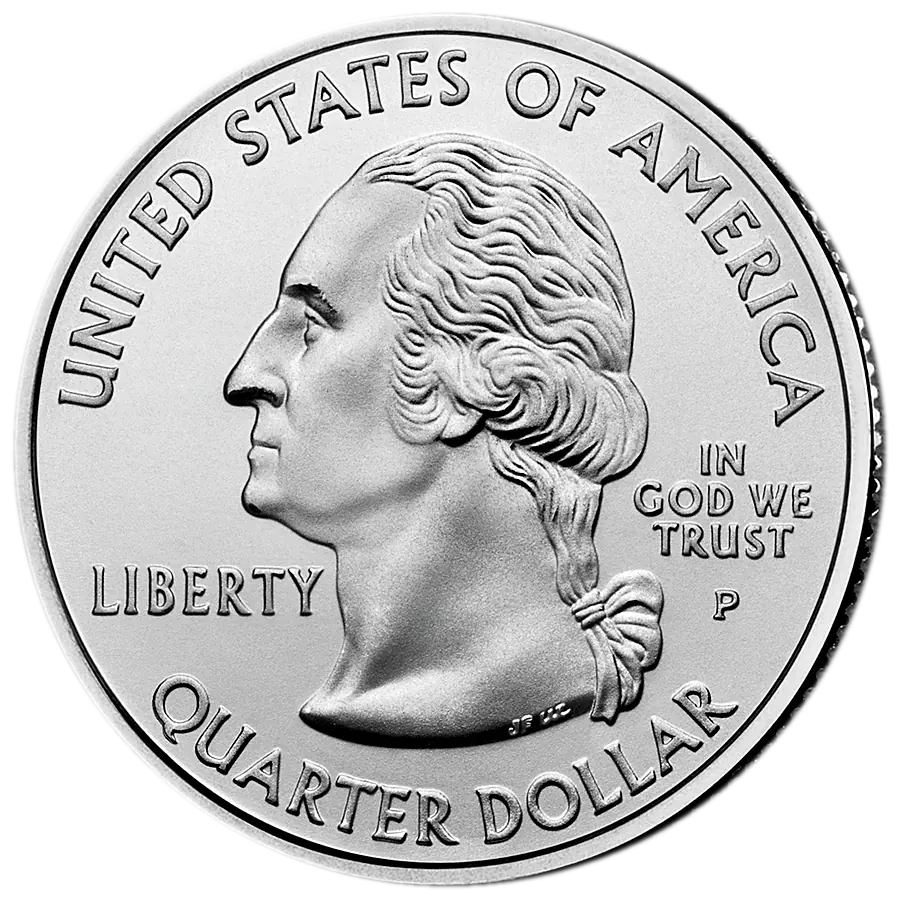
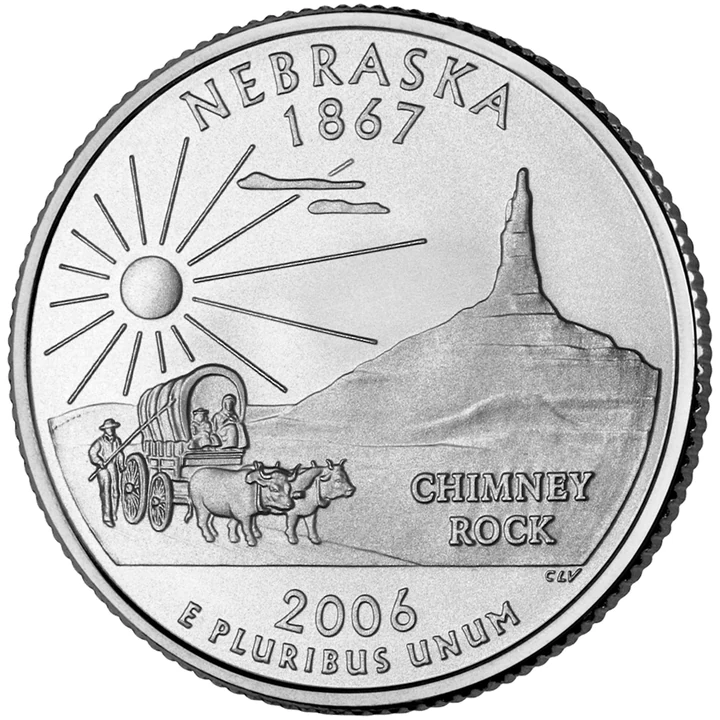
Exact Nebraska reverse from the U.S. Mint; shared program obverse.
37 / 50release order
4mint/finish issues
P · D · Smint marks
2006release year
Story in 30 Seconds
The reverse shows an ox-drawn covered wagon carrying a pioneer family toward the right, with the sun above and Chimney Rock rising behind. CHIMNEY ROCK, NEBRASKA, 1867, 2006, E PLURIBUS UNUM, RM, and CLV complete the reverse.
The Mint presents Chimney Rock as a famous North Platte Valley landmark and the wagon as the pioneering spirit. The landmark helped emigrants measure westward progress, but the scene is a symbolic composite rather than one identified family, journey, date, or trail train.
Nebraska's eight-member committee considered about 6,500 public submissions and forwarded four finalists. CCAC narrowly favored Standing Bear, CFA favored the State Capitol, and Governor Dave Heineman selected Chimney Rock in June 2005; the reviewed record does not preserve complete scoring, public-vote totals, or the signed recommendation.
Collectors distinguish P and D circulation strikes from S clad and 90% silver proofs. The canonical catalog models no Nebraska-specific major variety; extra spokes, doubled rock, missing ox legs, and hidden figures require repeatable die evidence and are not automatically mint varieties.
Public Law 105-124 ordered state reverses by constitutional ratification or admission. Nebraska entered the Union on March 1, 1867 as the thirty-seventh state, making this the program's thirty-seventh coin and second 2006 release. One reverse could not encompass Indigenous homelands and living nations, forced removal, agriculture and labor, railroads, cities, migration, water, ecology, or contemporary life. Nebraska selected a western trail landmark and wagon as a concise but partial identity.
Chimney Rock rises above the North Platte Valley in western Nebraska. Long before statehood and overland emigration, this region was and remains connected to Indigenous peoples. During nineteenth-century migration, travelers on the Oregon, California, and Mormon Pioneer routes used the formation as a visible progress marker and recorded it frequently in diaries. Erosion has changed its silhouette. The quarter remembers emigrants' viewpoint while omitting the peoples whose lands the trails crossed and the consequences of settlement.
Richard Masters organized the drawing around two unequal silhouettes: the broad wagon and ox team in the foreground and Chimney Rock's narrow spire in the distance. Charles L. Vickers translated the drawing into shallow relief, separating harness, wheels, passengers, rock, sun, ground, and inscriptions at quarter scale.
The Mint calls Chimney Rock one of the West's famous landmarks and connects the wagon to pioneers. NPS explains its practical meaning: visible for miles beside the North Platte route, it marked progress and appeared in more Oregon Trail emigrant diaries than any other landmark. It was orientation point, spectacle, and memory—not a destination by itself.
World Coin Book interpretation: the wagon's rightward motion makes migration the narrative action, while the vertical rock acts as a fixed witness behind it. The bright sun and open field simplify danger, fatigue, death, weather, river crossings, and uncertainty into an optimistic civic emblem; that reading is editorial, not an official formula.
The design honors vitality, spirit, and determination in Nebraska's official account. It also participates in the traditional pioneer story, which can obscure Native sovereignty, displacement, military violence, trail impacts, women and children's labor, disease, unsuccessful journeys, and the varied motives of emigrants. Those omissions matter when reading the coin historically.
The relief does not identify a family, number or sex of travelers, wagon model, ox breed, exact trail, season, time of day, viewpoint, or dated passage. CHIMNEY ROCK names the landmark; it does not prove the pictured wagon is on one exclusively named trail or that all western migration followed this route.
The federal framework asked each governor to develop three to five concepts through a state process. The Mint screened legality and coinability, produced candidate artwork, consulted CFA and CCAC, returned approved choices for state recommendation, and the Treasury Secretary retained final approval.
Nebraska Secretary of State John Gale chaired an eight-member committee with Tom Bassett, Virgil Marshall, Roger Bruhn, Norman Geske, Michael Schuyler, Gordon Howard, and Jodi Rave. The official state account says the committee considered about 6,500 public submissions between 2003 and 2005 and forwarded four finalists to Governor Dave Heineman.
The documented finalists were Chimney Rock; the State Capitol with HOME OF THE UNICAMERAL; The Sower with HOME OF ARBOR DAY; and Ponca Chief Standing Bear with EQUALITY BEFORE THE LAW. The reviewed record does not identify every submitter, preserve all 6,500 entries, or explain the committee's complete screening rubric and vote.
At the January 25, 2005 federal review, CCAC scored Standing Bear 20, Chimney Rock 19, The Sower 9, and the Capitol 2. CFA instead preferred the Capitol for its architectural significance and treated Standing Bear as second choice. These advisory results show that Chimney Rock was not a unanimous federal favorite.
Governor Heineman announced Chimney Rock as his selection in June 2005. Treasury approved the issued design; the Mint credits Richard Masters as designer and Charles L. Vickers as sculptor. No statewide winner-take-all public ballot is claimed: public participation is documented through submissions, while a complete public-vote record, signed governor recommendation, Treasury instrument, and concept-to-die change log were not located.
Procedures varied by state and changed during the program; each researched state page must document its actual path.
Alternative Designs
Four documented finalists represented different Nebraska identities: Chimney Rock and overland migration; the architecturally prominent State Capitol and unicameral legislature; The Sower and Arbor Day; and Ponca Chief Standing Bear with the constitutional motto EQUALITY BEFORE THE LAW. CCAC narrowly preferred Standing Bear, while CFA preferred the Capitol. Complete finalist artwork rights, public-submission authorship, committee scoring, state feedback, and final revision history remain unavailable, so no reconstructed gallery is published.
Use the complete text cards below as the keyboard and screen-reader equivalent of the image.
Ox-drawn covered wagon and pioneer family
Official explanation: The Mint identifies an ox-drawn covered wagon carrying pioneers; Nebraska calls it a pioneer family and links it to vitality, spirit, and determination.
Historical context: Ox teams and covered wagons became durable symbols of overland migration, though travelers' experiences, motives, labor, and outcomes varied greatly.
World Coin Book interpretation: The long horizontal team supplies motion and human scale; it is a symbolic group, not an identified family or documented passage.
Official explanation: The Mint names the North Platte Valley landmark and places it behind the wagon.
Historical context: Visible for miles, the eroding formation helped trail travelers judge westward progress and was repeatedly recorded in emigrant diaries.
World Coin Book interpretation: Its narrow vertical spire anchors the broad moving wagon and makes place, rather than a named person, the visual climax.
Official explanation: The Mint identifies a bright sun above the wagon; official descriptions do not assign a precise time, season, or route.
Historical context: Actual overland travel involved changing weather, difficult terrain, river crossings, illness, and risk that the simplified scene does not show.
World Coin Book interpretation: The open field keeps the tiny harness and passengers legible and gives the civic memory an optimistic forward rhythm.
CHIMNEY ROCK · NEBRASKA · 1867 · 2006 · E PLURIBUS UNUM · RM · CLV
Official explanation: The inscriptions name the landmark, state, admission year, issue year, national motto, designer Richard Masters, and sculptor Charles L. Vickers.
Historical context: IN GOD WE TRUST and the P, D, or S mint mark appear on the shared Washington obverse.
World Coin Book interpretation: CHIMNEY ROCK labels the distant silhouette while peripheral dates connect statehood order to the 2006 release.
The named western Nebraska landform and principal background landmark.
Overland emigrants
The symbolic wagon travelers; no individual family is identified.
North Platte Valley
The geographic corridor in which Chimney Rock served as a visible marker.
Ponca Chief Standing Bear
Civil-rights figure represented by a documented finalist, not the issued reverse.
Richard Masters and Charles L. Vickers
The credited reverse designer and sculptor.
Focused Timeline
Indigenous homelands
Major overland migration
Statehood
Program authorization
Public submissions
Federal advisory review
Governor selection
Quarter released
Lincoln launch
Official Explanation and Interpretation
Artists and relief
John Flanagan's Washington portrait, adapted and sculpted for the program by William Cousins, appears on the shared obverse. The state committee and public submissions supplied themes, but the reviewed record does not identify a citizen author of the exact issued composition. The Mint credits Artistic Infusion Program artist Richard Masters with the reverse design and Sculptor-Engraver Charles L. Vickers with translating it into coin relief. The complete drawing, model, lettering, hub, and die revision history was not located.
P and D are circulation issues. Both S issues were sold in proof products; the silver proof is a distinct 90% silver composition. Mintages are established catalog figures retained with an explicit source-audit limit.
Identification Guide
Identify the reverse by the ox team and covered wagon, Chimney Rock, sun, and CHIMNEY ROCK inscription. P, D, or S is on the obverse near Washington's hair ribbon. P and D are circulation strikes; S coins are proofs. The clad proof has a copper-colored edge core and weighs 5.67 g; the 90% silver proof lacks that stripe and weighs about 6.25 g.
Condition Guide
Inspect Chimney Rock's tip and edges; ox heads, backs, legs, and harness; wagon cover, passengers, wheel hubs, rims, and spokes; sun; RM and CLV; and fine lettering. First wear dulls exposed ox backs, the wagon cover and wheel details, and the rock's high edge. Luster in shallow legs, harness, spokes, or letters can indicate weak strike or grease rather than wear.
Open sky and wagon cover reveal contact marks, scrapes, cleaning, and wheel marks; dense harness, passengers, and spokes can conceal hits. Proofs require checks for hairlines, haze, milk spots, fingerprints, frost breaks, and impaired mirrors. Judge apparent extra spokes, doubled rock, missing legs, strike weakness, wear, and damage separately.
Mint Errors vs. Damage
The canonical Nebraska catalog models no recognized major variety beyond the four normal mint-and-finish issues. Seller labels such as extra spoke, doubled Chimney Rock, missing ox leg, extra passenger, doubled sun, floating wagon, or hidden face are not catalog attributions without a stable parent issue, repeatable die markers, and specialist documentation.
Genuine mint errors can include off-center strikes, broadstrikes, clips, wrong planchets, struck-through material, retained cuds, or substantial die cracks. Authentication requires mint-made geometry, metal flow, weight, and repeatable evidence rather than an accidental shape resembling a person, animal, letter, or second rock.
Weak strike or grease may soften ox legs, harness, passengers, spokes, rock edges, inscriptions, or artist initials. Machine doubling and die deterioration can create flat shelf-like outlines; these are not automatically doubled dies, and crossing harness lines do not prove an extra-limb variety.
Scratches, gouges, dents, flattened rims, dryer damage, glue, corrosion, plating disturbance, polishing, paint, heat color, and carving are post-mint damage. Chimney Rock is not a volcano; the sun is not an explosion; the wagon is not documented as a Pony Express stagecoach, Conestoga model, or one named family's vehicle; and erosion did not occur because the coin shows a different silhouette.
Why Collectors Care
Durable value tiers
Ordinary worn P and D examples generally occupy the face-value design-set tier. Better circulation coins attract interest through full luster, a clean sky and wagon cover, a sharp rock tip, separated ox legs and harness, complete wheel spokes, and legible RM and CLV. Clad proofs form a collector-product tier; silver proofs add 90% silver as a separate composition tier. Unsupported wagon or rock error labels alone do not create a premium. World Coin Book gives no live price promise: compare dated completed transactions for the exact mint, finish, grade, surfaces, and authenticated error status.
Official law and U.S. Mint records establish program facts and image identity. World Coin Book separates official explanation, historical analysis, and editorial interpretation.
Official descriptions, historical context, and World Coin Book interpretation are labeled separately. No live prices are asserted. Last verified:
The state committee's creating instrument, appointment dates, complete meeting files, attendance, minutes, votes, minority views, screening rubric, scores, and signed four-finalist recommendation were not located.
The approximately 6,500 public submissions, eligibility rules, submission form, narratives, submitter identities, preservation location, and complete screening record were not located.
A 2004 library record indicates some public voting on finalists, but no statewide ballot, electorate definition, dates, complete totals, duplicate controls, geographic distribution, certification, or legal weight was located; this page therefore documents public submissions without claiming a binding public vote.
Federal records preserve four finalist themes and advisory preferences, but the complete candidate artwork, artist assignments, state feedback, and mapping from public concepts through Mint drawings to the issued relief remain incomplete.
The signed Governor Heineman recommendation, Treasury final-approval instrument, complete correspondence, and full change log from concept through drawing, model, lettering, hub, die, and issued relief remain unavailable.
Official sources do not identify a particular family, traveler count, names, wagon model, ox breed, exact trail, date, season, time, route direction, viewpoint, or symbolic number of people.
The official Mint page's 445-foot base-to-tip figure and NPS's more-than-300-foot rise use different reference points; the page avoids treating them as a contradiction or converting either into a precise current height without a common survey datum.
The canonical catalog has no normalized Nebraska-specific variety row. Future extra-spoke, doubled-rock, missing-leg, or passenger attribution should require stable die markers and specialist documentation.
Normalized mintages remain established catalog figures; future work should attach direct Mint annual-production and proof-sales evidence for every issue.