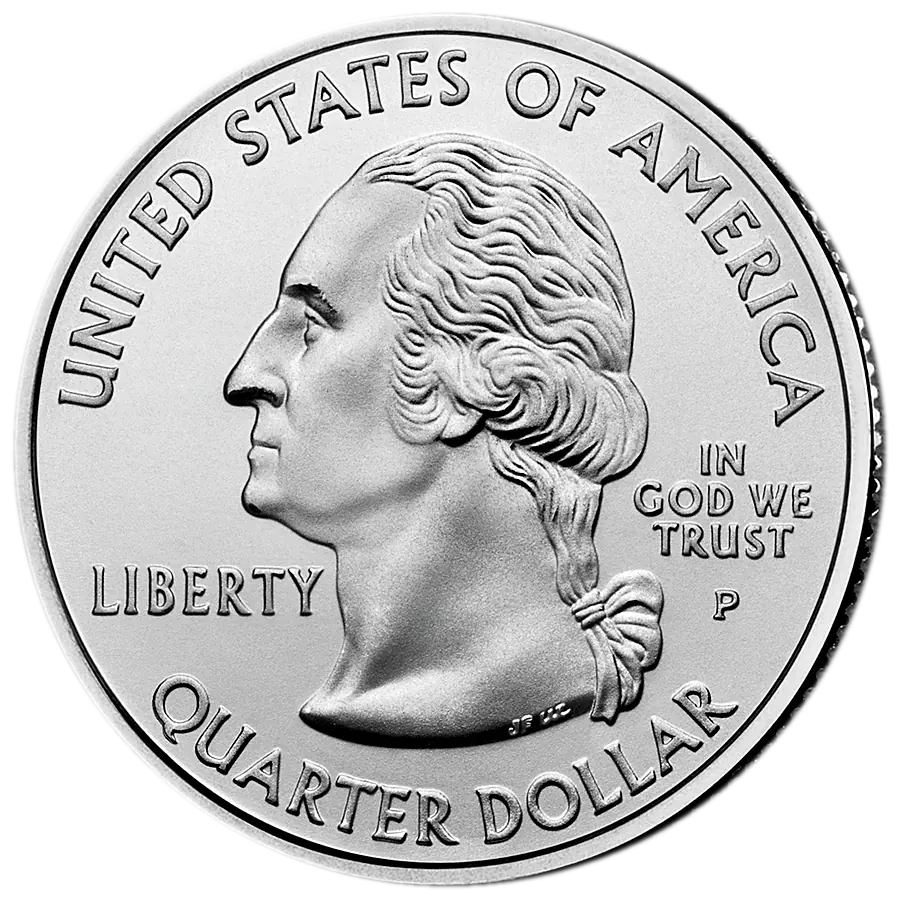
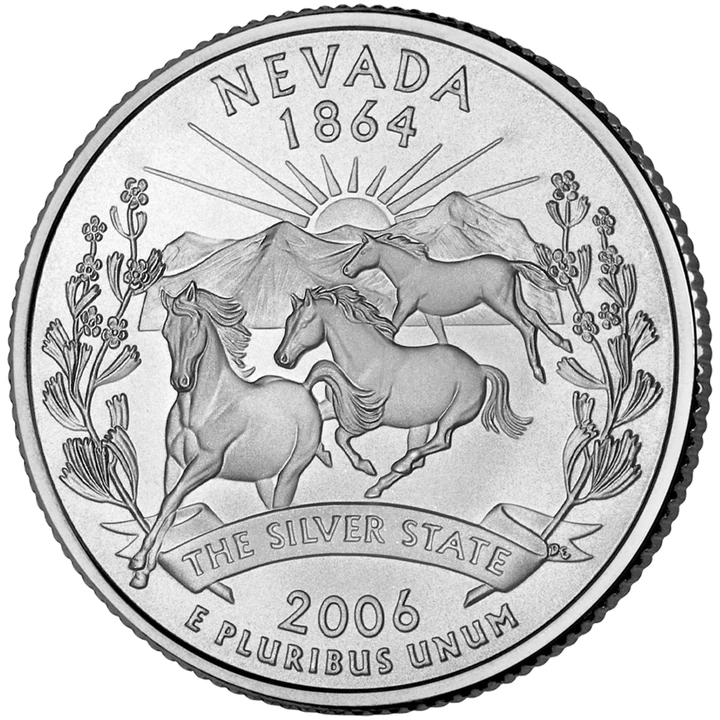
Exact Nevada reverse from the U.S. Mint; shared program obverse.
36 / 50release order
4mint/finish issues
P · D · Smint marks
2006release year
Story in 30 Seconds
The reverse shows three wild stallions running before snow-capped mountains and a rising sun, with sagebrush framing the lower field and THE SILVER STATE on a banner. NEVADA, 1864, 2006, E PLURIBUS UNUM, and Don Everhart's DE initials complete the reverse.
The Mint says the horses evoke freedom and Nevada's rugged beauty. Sagebrush is Nevada's official state flower; the mountain-and-basin setting connects the animals to a dry Great Basin landscape rather than to racing, ranch ownership, or one named herd.
Nevada used an 18-member commission and gathered public concepts. Five Mint drawings entered federal advisory review. A May 2005 public ballot drew about 59,000 votes in contemporary reporting; the running-horses design led with 32 percent and Governor Kenny Guinn advanced the public choice. The complete certified ballot and signed recommendation were not located.
Collectors distinguish P and D circulation strikes from S clad and 90% silver proofs. The canonical catalog models no Nevada-specific major variety; extra legs, doubled mountains, missing sagebrush, and hidden riders need repeatable die evidence and are not automatically mint varieties.
Public Law 105-124 ordered state reverses by constitutional ratification or admission. Nevada entered the Union on October 31, 1864 as the thirty-sixth state, making this the program's thirty-sixth coin and first 2006 release. One reverse could not encompass Indigenous homelands and living nations, mining and labor, federal land and military uses, cities, water, migration, tourism, nuclear testing, ranching, or contemporary life. Nevada's process selected open range, horses, mountains, sagebrush, sun, and a mining-era nickname as a concise but partial identity.
Nevada is a mountain-basin state whose dry public lands support sagebrush communities and many free-roaming horse herds under continuing federal management. Horses are culturally powerful but descend from domestic animals; their legal status, population, water use, gathers, fertility control, adoption, and effects on rangeland remain active policy questions. Silver transformed nineteenth-century Nevada and supplied the enduring nickname, although the reverse shows neither mine nor miner.
Don Everhart placed three horses in overlapping profiles across the center. Alternating legs, lifted tails, and forward-leaning bodies create motion while the low sagebrush border keeps the animals above the inscriptions. Everhart later recalled that the assigned elements were wild horses, sagebrush, a rising sun over mountains, and THE SILVER STATE.
The Mint's launch language reads the trio as freedom of the American spirit and Nevada's bold, rugged beauty. World Coin Book treats that as an official interpretation, not proof that the horses are three named animals, a family, a specific breed, or a documented herd. The official page calls them stallions; the relief does not provide biological evidence sufficient to sex each animal independently.
The scene combines two scales: large moving animals occupy the near field while repeated mountain ridges and a small sun imply Nevada's long basin-and-range horizons. Sagebrush both frames the composition and invokes an official state symbol. The design does not identify a particular peak, valley, sunrise date, herd-management area, or botanical specimen.
THE SILVER STATE introduces history without showing its costs or machinery. Nevada's official symbols connect silver to the state's past, while the banner visually gathers the sagebrush ends and anchors the horses. World Coin Book interpretation: movement across an open field makes freedom the design's dominant idea, while the banner turns landscape into state identity.
The portrait is deliberately selective. It omits Indigenous sovereignty and dispossession, Spanish and Mexican histories, the Comstock's workers and environmental effects, Chinese and other immigrant labor, ranching conflicts, Las Vegas and Reno, Hoover Dam and scarce water, federal installations, nuclear testing, and the continuing ecological and political debate around horse management.
The federal framework asked each governor to develop three to five concepts through a state process. The Mint screened legality and coinability, produced candidate artwork, consulted the Commission of Fine Arts and Citizens Coinage Advisory Committee, returned approved choices for state recommendation, and the Treasury Secretary retained final approval.
Nevada's quarter effort was led through the state treasurer's office with an 18-member commission. Contemporary accounts report public submissions, but the reviewed state archive does not preserve the creating order, complete roster, solicitation, eligibility rules, submission corpus, screening rubric, votes, or signed short list. Those details remain evidence gaps.
The five federal-review themes are documented in the January 25, 2005 CCAC minutes: Silver State with a miner, Nevada Wilderness with desert bighorn sheep, Morning in Nevada with wild horses, Nevada's Early Heritage with Indigenous artifacts, and a herd-of-wild-horses design. CFA and CCAC both preferred the bighorn-sheep candidate; CCAC also supported the miner. Their advice was consultative, not the final state choice.
Contemporary reporting says Nevada opened the five choices to online and mail voting in May 2005. About 59,000 ballots were cast; 32 percent favored the three running horses, with roughly one quarter of participation attributed to children. Because an official ballot form, full candidate totals, voter rules, controls, certification, and geographic breakdown were not located, the page attributes these figures and does not call the process a legally certified election.
Governor Kenny Guinn accepted the public preference and the issued design was later approved through Treasury. The Mint credits Don Everhart as both reverse designer and sculptor. The reviewed record does not preserve the governor's signed recommendation, Treasury approval instrument, state feedback, exact mapping between all five early drawings and the public ballot, or a complete concept-to-die change log.
Procedures varied by state and changed during the program; each researched state page must document its actual path.
Alternative Designs
Federal advisory records document five Nevada drawings: Silver State (miner), Nevada Wilderness (desert bighorn sheep), Morning in Nevada (wild horses), Nevada's Early Heritage (Indigenous artifacts), and Herd of Wild Horses. CFA and CCAC preferred the bighorn sheep and suggested enlarging the mountains and changing or removing mottos; CCAC also supported the miner. Complete state-submission authorship, public-ballot artwork, candidate vote totals beyond the winner, and final revision history remain unavailable, so no reconstructed gallery is published.
Use the complete text cards below as the keyboard and screen-reader equivalent of the image.
Three running mustangs
Official explanation: The Mint identifies three wild stallions and says their motion captures freedom of the American spirit and Nevada's rugged beauty.
Historical context: Nevada contains many federally managed free-roaming horse herds; their protection and ecological management have long histories and remain contested.
World Coin Book interpretation: Overlapping bodies and alternating legs carry the eye from left to right; the horses represent motion and openness, not a documented breed, family, or named herd.
Official explanation: The Mint identifies snow-capped mountains and a sun behind the horses.
Historical context: Nevada's landscape consists of repeated mountain ranges and dry intervening basins; no official source names the coin's range or viewpoint.
World Coin Book interpretation: Small receding ridges create distance while the sun centers the horizon and gives the running herd a forward, morning-like energy.
Official explanation: The Mint identifies sagebrush bordering the lower design; Nevada law designates sagebrush as the state flower.
Historical context: Sagebrush supplies food and shelter across Great Basin ecosystems and has long cultural uses; the stylized sprigs are not a botanical specimen.
World Coin Book interpretation: Mirrored sprays frame the banner and stabilize the fast-moving horses, joining living habitat to formal state symbolism.
Official explanation: The Mint identifies the banner as Nevada's nickname; state sources connect silver to Nevada history and official identity.
Historical context: The words invoke nineteenth-century silver without depicting miners, mills, labor, finance, pollution, or the Carson City Mint.
World Coin Book interpretation: The curved banner acts as a visual ground beneath the horses and converts an open landscape into a declared civic portrait.
Official explanation: The inscriptions give state, admission year, issue year, national motto, and Don Everhart's initials as reverse designer and sculptor.
Historical context: IN GOD WE TRUST and the P, D, or S mint mark appear on the shared Washington obverse, not in the horse scene.
World Coin Book interpretation: Peripheral lettering contains the diagonal motion while 1864 and 2006 link statehood sequence to the coin's release.
The central animals and an enduring, actively managed western symbol.
Great Basin landscape
The broad mountain-and-basin setting implied rather than geographically identified.
Sagebrush
Nevada's official state flower and the design's lower botanical frame.
The Silver State
Mining-era nickname carried on the reverse banner.
Velma B. Johnston
Nevada advocate known as Wild Horse Annie whose campaign shaped federal protection history; she is not pictured.
Don Everhart
U.S. Mint sculptor-engraver credited with both reverse design and sculpture.
Focused Timeline
Indigenous homelands
Comstock silver
Statehood
Wild Horse Annie Act
Nevada Wild Horse Range
Federal protection and management
Program authorization
Federal advisory review
Public ballot
Quarter issued
Carson City launch
Official Explanation and Interpretation
Artists and relief
John Flanagan's Washington portrait, adapted and sculpted for the program by William Cousins, appears on the shared obverse. The state supplied themes and the public preferred running horses, but the reviewed record does not identify a citizen author of the exact issued composition. The U.S. Mint credits Don Everhart as reverse designer and sculptor. Everhart said he had to combine wild horses, sagebrush, a rising sun over mountains, and THE SILVER STATE; he used motion, botanical framing, and the banner to make those assigned elements coherent in shallow relief. The complete drawing-to-model-to-die revision record was not located.
P and D are circulation issues. Both S issues were sold in proof products; the silver proof is a distinct 90% silver composition. Mintages are established catalog figures retained with an explicit source-audit limit.
Identification Guide
Identify the reverse by three running horses, mountain ridges and sun, sagebrush at the lower sides, and THE SILVER STATE banner. P, D, or S is on the obverse near Washington's hair ribbon. P and D are circulation strikes; S coins are proofs. The clad proof has a copper-colored edge core and weighs 5.67 g; the 90% silver proof lacks that stripe and weighs about 6.25 g.
Condition Guide
Inspect horse heads, ears, shoulders, backs, hips, legs and tails; mountain crests; sun; sagebrush tips; banner folds and letters; dates, motto, and DE initials. First wear dulls the exposed horse shoulders, backs and hips and interrupts luster. Soft legs, facial detail, mountain lines, foliage, or letters that retain luster may be weak strike, grease, die polish, or die state rather than wear.
Open sky and the smooth horse bodies reveal contact marks, scrapes, cleaning and wheel marks; dense legs, sagebrush and mountain lines can conceal hits. Proofs require checks for hairlines, haze, milk spots, fingerprints, frost breaks and impaired mirrors. Judge apparent extra legs, doubled outlines, missing foliage, strike weakness, wear and post-mint damage separately.
Mint Errors vs. Damage
The canonical Nevada catalog models no recognized major variety beyond the four normal mint-and-finish issues. Seller labels such as extra leg, doubled horse, missing tail, extra sun, doubled mountain, missing sagebrush, or hidden rider are not catalog attributions without a stable parent issue, repeatable die markers, and specialist documentation.
Genuine mint errors can include off-center strikes, broadstrikes, clips, wrong planchets, struck-through material, retained cuds, or substantial die cracks. Authentication requires mint-made geometry, metal flow, weight, and repeatable evidence rather than an accidental shape resembling a rider, foal, wolf, bird, face, letter, or fourth horse.
Weak strike or grease may soften thin legs, ears, tails, sagebrush, mountain lines, inscriptions, or DE initials. Machine doubling and die deterioration can create flat shelf-like outlines. These production effects are not automatically doubled dies, and normal overlapping legs do not prove an extra-limb variety.
Scratches, gouges, dents, flattened rims, dryer damage, glue, corrosion, plating disturbance, polishing, paint, heat color and carving are post-mint damage. The coin does not identify the horses as mustang breeds, a family, Wild Horse Annie's animals, Pony Express mounts, or a specific herd; the sun is not a nuclear explosion, and the mountains are not an authenticated named range.
Why Collectors Care
Durable value tiers
Ordinary worn P and D examples generally occupy the face-value design-set tier. Better circulation coins attract interest through full luster, clean sky and horse bodies, separated legs and tails, sharp sagebrush, mountain ridges, banner, inscriptions, and legible DE. Clad proofs form a collector-product tier; silver proofs add 90% silver as a separate composition tier. Unsupported horse-error labels alone do not create a premium. World Coin Book gives no live price promise: compare dated completed transactions for the exact mint, finish, grade, surfaces, and authenticated error status.
Official law and U.S. Mint records establish program facts and image identity. World Coin Book separates official explanation, historical analysis, and editorial interpretation.
Official descriptions, historical context, and World Coin Book interpretation are labeled separately. No live prices are asserted. Last verified:
The Nevada quarter commission's creating instrument, complete 18-member roster, appointments, authority, meetings, attendance, minutes, votes, minority views, screening rubric, scores, and signed state short list were not located in the reviewed official archive.
The complete public solicitation, eligibility rules, submission form, concept corpus, narratives, submitter identities, preservation location, and state screening record were not located.
Contemporary reporting gives about 59,000 online and mail ballots, a 32 percent winning share, and substantial child participation, but no official ballot, electorate definition, dates, full candidate totals, turnout denominator, duplicate controls, geographic distribution, certification, or legal weight was located.
Federal records identify five themes, but the exact public-ballot artwork, all artist assignments, state feedback, and mapping from state concepts through Mint drawings to Don Everhart's issued relief remain incomplete.
The signed Governor Guinn recommendation, Treasury final-approval instrument, complete state correspondence, and full change log from concept through drawing, model, lettering, hub, die, and issued relief remain unavailable.
Official sources do not identify the horses' breed, sex by independent relief evidence, ages, relationship, names, exact herd, direction, speed, or count symbolism; nor do they identify a precise mountain range, peak, valley, viewpoint, sunrise date, sagebrush specimen, or hidden figure.
The phrase 'home to most of the Nation's wild horses' is time-sensitive and depends on agency jurisdiction and estimate date. The page keeps it as attributed 2006 Mint context rather than a timeless biological fact.
The canonical catalog has no normalized Nevada-specific variety row. Future extra-leg, doubled-horse, missing-sagebrush, or mountain-line attribution should require stable die markers and specialist documentation.
Normalized mintages remain established catalog figures; future work should attach direct Mint annual-production and proof-sales evidence for every issue.