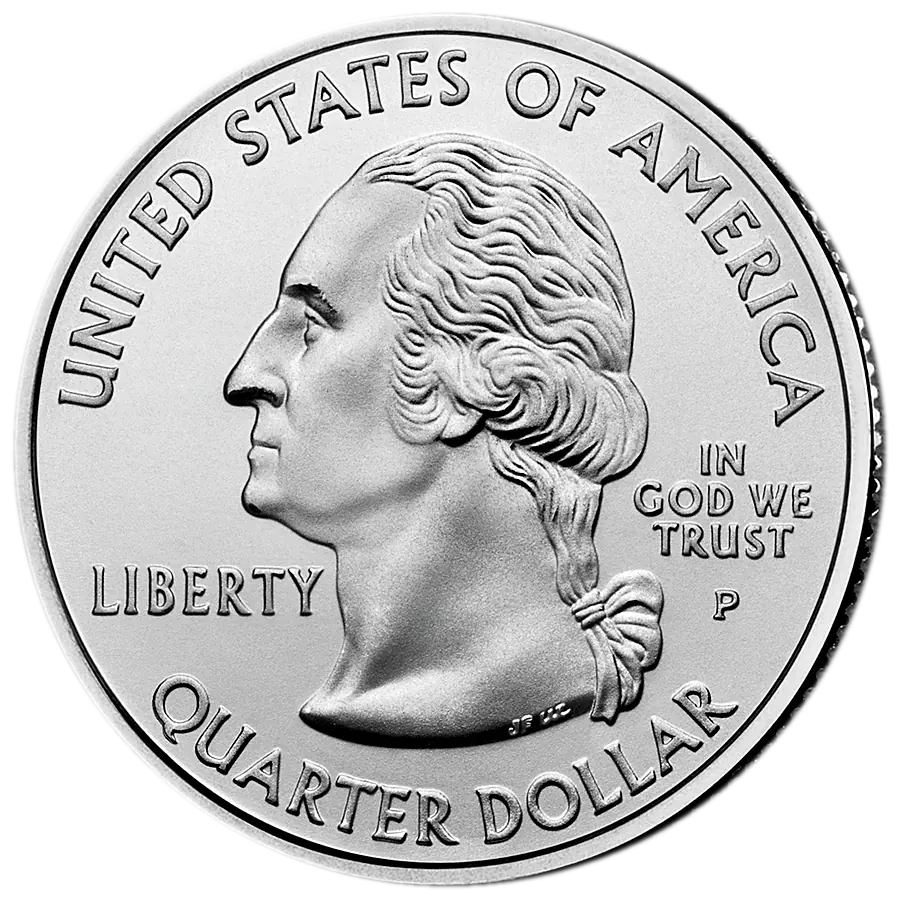
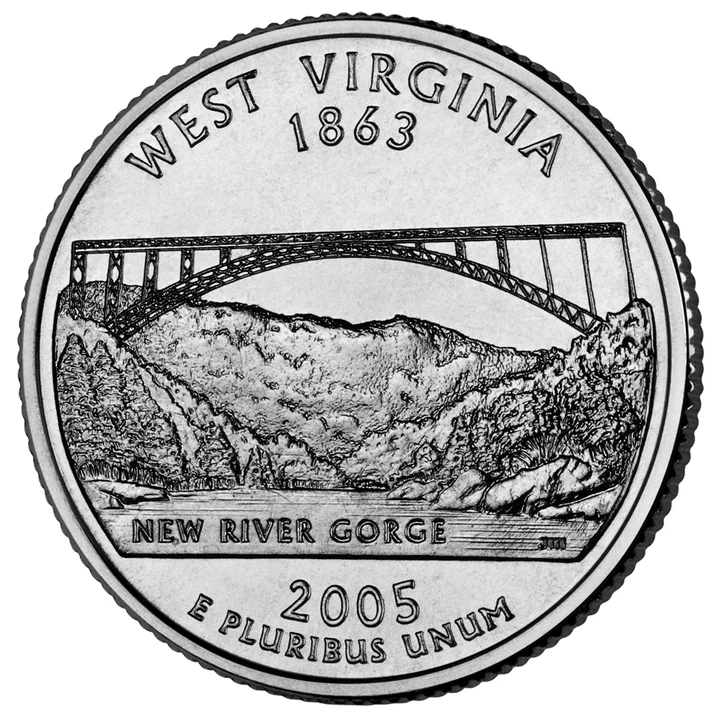
Exact West Virginia reverse from the U.S. Mint; shared program obverse.
35 / 50release order
4mint/finish issues
P · D · Smint marks
2005release year
Story in 30 Seconds
The reverse shows the New River Gorge Bridge spanning the New River between steep wooded gorge walls. WEST VIRGINIA, 1863, NEW RIVER GORGE, 2005, and E PLURIBUS UNUM surround the scene; IN GOD WE TRUST is on the shared Washington obverse.
The Mint presents the design as both scenic beauty and an engineering triumph. Completed in 1977, the bridge carried U.S. Route 19 across terrain where the earlier winding trip took about 40 minutes; the crossing reduced it to less than a minute.
West Virginia transportation history says state residents chose the symbol. The reviewed official record does not preserve the complete state solicitation, 1,800-plus submission corpus reported by later institutional tourism history, finalist artwork, vote method or totals, governor recommendation, or Treasury approval instrument, so this page does not invent those steps.
Collectors distinguish P and D circulation strikes from S clad and 90% silver proofs. The canonical catalog models no West Virginia-specific major variety; extra cables, doubled rails, missing trees, and floating-bridge labels require repeatable die evidence and are not automatically mint varieties.
Public Law 105-124 ordered state reverses by constitutional ratification or admission. West Virginia entered the Union on June 20, 1863 as the thirty-fifth state, making this the program's thirty-fifth coin and fifth 2005 release. One reverse could not encompass Indigenous homelands, Civil War statehood, extraction and labor, railroads, towns, cities, Black history, migration, environmental change, or contemporary life. The bridge-and-gorge scene selected connection and landscape as a concise but incomplete identity.
The lower New River crosses a deeply incised Appalachian landscape in southern West Virginia. Long Indigenous histories preceded statehood; railroads, coal and timber later reshaped the gorge and its communities. The 1977 bridge solved a modern highway problem while becoming a scenic landmark. The coin's quiet panorama omits workers, earlier roads and crossings, displaced or diminished communities, extractive industry, Indigenous names and living nations, and the river's ecological complexity.
John Mercanti organized the reverse around the bridge's long horizontal deck and single steel arch. Gorge walls descend from both sides toward the narrow river, while open metal above the deck separates the structure from WEST VIRGINIA and makes the span legible at quarter scale.
Official Mint language joins natural splendor to engineering ingenuity, strength and indispensability. The state and NPS records explain the practical basis: Michael Baker Company designed a 3,030-foot crossing, American Bridge Division of U.S. Steel built it, and the 1,700-foot arch met above a gorge more than 800 feet deep.
World Coin Book reads the arch as a visual answer to the V-shaped gorge: a manufactured curve bridges two natural slopes, turning obstruction into connection. That is editorial interpretation, not an official symbolic formula. The coin does not show a literal traffic moment, Bridge Day jumpers, construction stage, season, or exact viewpoint.
Weathering steel gave the real bridge a rust-colored protective surface that avoided routine painting, but an uncolored coin cannot communicate that material distinction. Fine verticals and deck lines convey engineering rhythm while the simplified trees and water establish scale rather than botanical or hydrological inventory.
The design emphasizes connection, technical ambition, scenic tourism and a modern landmark. It omits the workers and construction death, the older Fayette Station route, rail and mining communities, Indigenous history, extraction, labor conflict, environmental costs, statehood conflict, and most northern and urban West Virginia.
The federal program invited each governor to use a state process to develop concepts; the Mint tested legality and coinability, advisory bodies reviewed artwork, the governor recommended a preferred design, and the Treasury Secretary retained final approval.
West Virginia Department of Transportation states that residents chose the bridge symbol. A later institutional tourism account reports more than 1,800 statewide submissions and says Governor's School for the Arts students narrowed them to five finalists. Because the reviewed primary state archive does not preserve the solicitation, student authority, names, dates, scores, or full corpus, those details remain attributed rather than treated as a complete primary record.
Documented proposed themes in that later account include Appalachian Mountains, Bridge Day, Mother's Day, and river rafting, alongside the selected New River Gorge Bridge. The reviewed official record does not establish exact titles, artwork, authors, whether these names exhaust the five finalists, or how concepts became Mint drawings.
The transportation record says residents chose the symbol; no official ballot instrument, electorate definition, method, dates, candidate totals, turnout, controls, or certification was located. The page therefore does not call this a verified statewide popular vote.
The Mint credits John Mercanti as reverse designer and sculptor. The reviewed record does not preserve the signed governor recommendation, complete CFA or CCAC West Virginia deliberation, Treasury approval instrument, artist assignments for alternatives, or a concept-to-die revision log.
Procedures varied by state and changed during the program; each researched state page must document its actual path.
Alternative Designs
A later institutional tourism history names Appalachian Mountains, Bridge Day, Mother's Day, and river rafting among suggested finalist themes. It also says five finalists existed, but those four names plus the selected bridge cannot be mapped to preserved official artwork, authors, numbering, vote totals, or Mint artist assignments. The page publishes no reconstructed gallery and treats the complete finalist record as unresolved.
Use the complete text cards below as the keyboard and screen-reader equivalent of the image.
New River Gorge Bridge
Official explanation: The Mint identifies the steel-arch bridge as West Virginia's engineering triumph and a symbol of ingenuity and strength.
Historical context: Opened in 1977, the U.S. Route 19 bridge connected communities and reduced the former winding-road trip from about 40 minutes to less than one minute.
World Coin Book interpretation: The long deck and rising arch dominate the field, making connection—not traffic or recreation—the central visual action.
Official explanation: The Mint identifies the north-flowing New River and deep gorge as the scenic setting around the bridge.
Historical context: The gorge exposes Appalachian rock layers and contains long human histories; the claim that the New is among the world's oldest rivers is not a precisely settled rank.
World Coin Book interpretation: The narrow water line and converging slopes magnify the arch's scale while subordinating the river to the crossing.
Official explanation: Official sources identify the bridge and scenic gorge but do not assign separate meanings to every girder, tree, rock, or water line.
Historical context: The real structure uses weathering steel and a 1,700-foot arch within a 3,030-foot crossing; the coin simplifies those systems for relief.
World Coin Book interpretation: Repeated verticals create measured rhythm; dark slopes frame a bright arch and broad sky so engineering remains readable at small scale.
WEST VIRGINIA · 1863 · NEW RIVER GORGE · 2005 · E PLURIBUS UNUM · JM
Official explanation: The inscriptions give state, admission year, named place, issue year, national motto, and John Mercanti's initials as reverse designer and sculptor.
Historical context: IN GOD WE TRUST and the mint mark appear on the shared obverse, not beside the bridge.
World Coin Book interpretation: NEW RIVER GORGE labels the place rather than the bridge alone, binding engineered span to landscape and state chronology.
U.S. Route 19 steel-arch bridge and central subject of the reverse.
New River
North-flowing Appalachian river shown beneath the bridge.
New River Gorge
Landscape, communities, histories, and present national park-and-preserve setting around the crossing.
Michael Baker Company
Engineering firm selected to design the bridge.
American Bridge Division of U.S. Steel
Construction contractor that erected the bridge.
John Mercanti
U.S. Mint artist credited as reverse designer and sculptor.
Focused Timeline
Indigenous presence
Statehood
Railroad and extraction
Construction contract
Steel erection
Arch closure
Bridge opens
Program authorization
Quarter release and launch
National Register
National park redesignation
Official Explanation and Interpretation
Artists and relief
John Flanagan's Washington portrait, adapted and sculpted for the program by William Cousins, appears on the shared obverse. West Virginians submitted concepts and the state says residents chose the bridge symbol, but the reviewed official record does not identify one citizen concept author or preserve a complete finalist-to-artwork chain. The U.S. Mint credits John Mercanti as reverse designer and sculptor, translating the approved bridge-and-gorge subject into shallow relief. Michael Baker Company designed the real bridge; that engineering authorship is distinct from Mercanti's coin authorship. A complete change log from submissions through drawings, models, hubs, dies, and production was not located.
P and D are circulation issues. Both S issues were sold in proof products; the silver proof is a distinct 90% silver composition. Mintages are established catalog figures retained with an explicit source-audit limit.
Identification Guide
Identify the reverse by one steel arch bridge spanning a narrow river between steep wooded walls, with NEW RIVER GORGE below. P, D, or S appears on the obverse near Washington's hair ribbon. P and D are circulation strikes; S issues are proofs. The clad proof has a copper-colored edge core and weighs 5.67 g; the 90% silver proof lacks that stripe and weighs about 6.25 g.
Condition Guide
Inspect the bridge deck, crown and springing of the arch, thin vertical supports, gorge ridges, tree tips, river line, NEW RIVER GORGE letters, dates, motto, and JM initials. First wear dulls exposed bridge and ridge high points and interrupts luster. Soft verticals, trees, water, or lettering that retain luster may be weak strike, grease, die polish, or die state rather than wear.
The broad sky and water fields reveal contact marks, scrapes, residue, cleaning and wheel marks; dense bridge and tree detail can conceal hits. Proofs require checks for hairlines, haze, milk spots, fingerprints, frost breaks and impaired mirrors. Judge bridge-line doubling, missing detail, strike weakness, wear and damage separately.
Mint Errors vs. Damage
The canonical West Virginia catalog models no recognized major variety beyond the four normal mint-and-finish issues. Seller labels such as extra cable, doubled bridge, missing trees, floating bridge, extra river, or hidden person are not catalog attributions without a stable parent issue, repeatable die markers, and specialist documentation.
Genuine mint errors can include off-center strikes, broadstrikes, clips, wrong planchets, struck-through material, retained cuds, or substantial die cracks. Authentication requires mint-made geometry, metal flow, weight, and repeatable evidence rather than resemblance to a vehicle, jumper, face, animal, word, or second structure.
Weak strike or grease may soften thin vertical supports, trees, river, inscriptions, or JM initials. Machine doubling and die deterioration can create flat shelf-like bridge or letter outlines. These production effects are not automatically doubled dies, and weathering steel's rust-like protective surface is not depicted as coin corrosion.
Scratches, gouges, dents, flattened rims, dryer damage, glue, corrosion, plating disturbance, polishing, paint, heat color and carving are post-mint damage. The coin does not show Bridge Day, a collapsing bridge, the Royal Gorge Bridge, a railroad bridge, a secret Mothman, or an exact vehicle; NEW RIVER GORGE is a place label, not an error inscription.
Why Collectors Care
Durable value tiers
Ordinary worn P and D examples generally occupy the face-value design-set tier. Better circulation coins attract interest through full luster, clean sky and river fields, a sharp arch and deck, separated vertical supports and trees, complete inscriptions, and legible JM. Clad proofs form a collector-product tier; silver proofs add 90% silver as a separate composition tier. Unsupported bridge-error labels alone do not create a premium. World Coin Book gives no live price promise: compare dated completed transactions for the exact mint, finish, grade, surfaces, and authenticated error status.
Official law and U.S. Mint records establish program facts and image identity. World Coin Book separates official explanation, historical analysis, and editorial interpretation.
Official descriptions, historical context, and World Coin Book interpretation are labeled separately. No live prices are asserted. Last verified:
The creating instrument, complete roster, appointments, authority, meetings, attendance, minutes, votes, minority views, screening rubric, scores, and signed state recommendation were not located in the reviewed official record.
The complete solicitation, eligibility rules, submission form, asserted 1,800-plus concept corpus, narratives, submitter identities, preservation location, and Governor's School for the Arts screening record were not located in a primary state archive.
The transportation record says residents chose the symbol, but no official electorate definition, ballot or poll method, dates, candidate totals, turnout denominator, duplicate controls, geographic distribution, certification, or legal weight was located. A verified statewide popular vote is not asserted.
The later institutional account says five finalists and names Appalachian Mountains, Bridge Day, Mother's Day, and river rafting besides the selected bridge, but complete candidate artwork, exact titles, authors, numbering, and mapping to Mint drawings were not located.
The signed governor recommendation, Treasury final-approval instrument, complete CFA and CCAC deliberations, state feedback, alternative artist assignments, and full change log from concept through drawing, model, lettering, hub, die, and issued relief remain unavailable.
Official sources do not identify every tree or rock, an exact coin viewpoint, season, weather, vehicle, worker, construction phase, river depth, symbolic count of supports, or hidden figure. None should be promoted as an attribution.
The repeated claim that the New River is one of the world's oldest lacks a precise comparable dating method and rank in the reviewed sources; the page treats its geologic antiquity cautiously rather than presenting a settled superlative.
The canonical catalog has no normalized West Virginia-specific variety row. Future attribution work should require stable die markers before adding extra-line, missing-detail, or doubled-bridge claims.
Normalized mintages remain established catalog figures; future work should attach direct Mint annual-production and proof-sales evidence for every issue.