One bison and one sunflower compress prairie ecology, Indigenous relationships, state symbolism, loss, survival, and a student-led choice into a spare Kansas emblem.
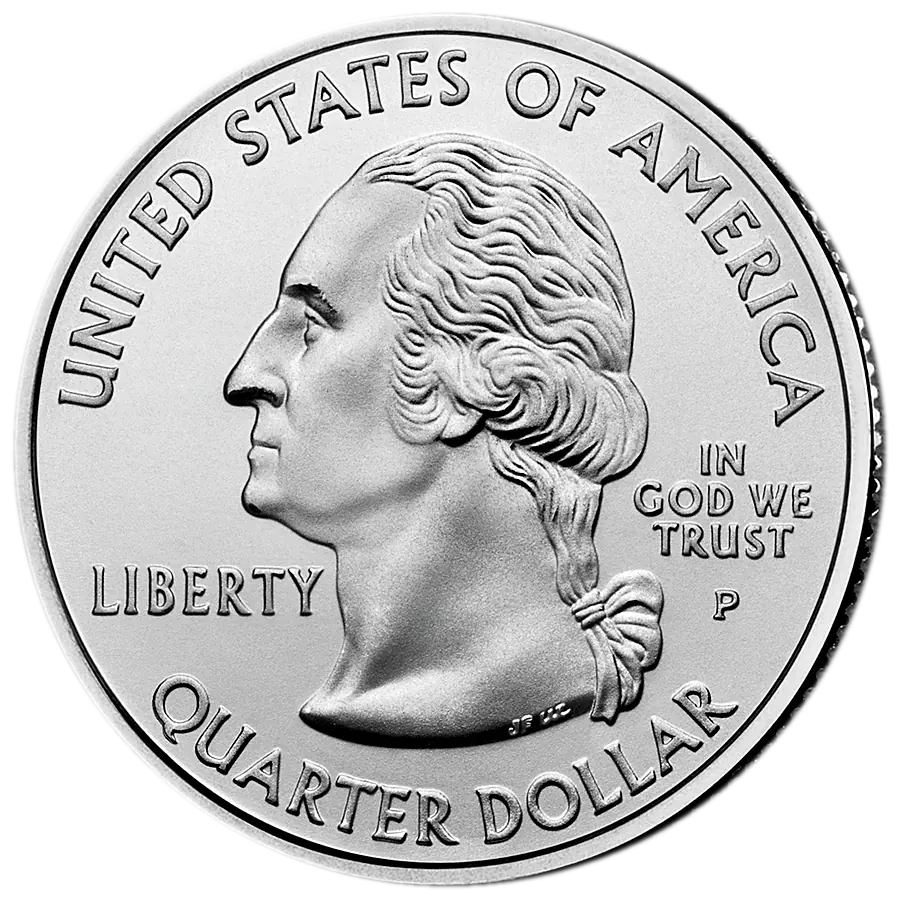
Exact Kansas reverse from the U.S. Mint; shared program obverse.
34 / 50release order
4mint/finish issues
P · D · Smint marks
2005release year
Story in 30 Seconds
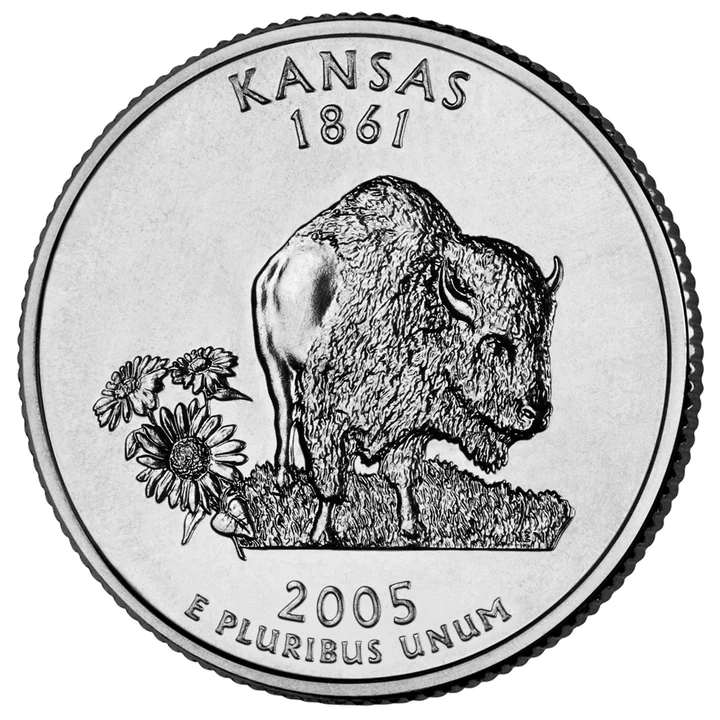
The reverse shows a left-facing American bison beneath KANSAS, with a large sunflower behind its shoulder and the dates 1861 and 2005 above E PLURIBUS UNUM. IN GOD WE TRUST is on the shared Washington obverse, not the Kansas reverse.
The Mint calls the bison and sunflower two of Kansas's best-known symbols. It links the bison to millions once roaming Kansas prairie and the sunflower to Native cultivation more than 3,000 years ago and its continuing presence along Kansas fields and roadsides.
Kansas law created a 16-member commission, invited Kansans to submit sketches and narratives, required five finalists, and provided for a statewide high-school election. The Kansas Historical Society records 40,080 ballots and selection of the bison-and-sunflower design; Governor Kathleen Sebelius forwarded the result for federal approval.
Collectors distinguish P and D circulation strikes from S clad and 90% silver proofs. No separate Kansas variety is modeled in the canonical catalog. The famous weak-T 'IN GOD WE RUST' appearance is grease-filled-die weakness on the obverse, not a changed motto or fifth issue.
Public Law 105-124 ordered state reverses by constitutional ratification or admission. Kansas entered the Union on January 29, 1861 as the thirty-fourth state, so this is the program's thirty-fourth coin and fourth 2005 release. One reverse could not encompass the homelands and sovereignty of Tribal nations, Bleeding Kansas, agriculture, railroads, aviation, towns, cities, migration, drought, energy, or modern Kansas. The issued design chose two living prairie symbols as a concise but partial identity.
Kansas lies across the central Great Plains, where bison, grasses, flowering plants, fire, water, climate, and human communities shaped one another. Bison were foundational to many Plains Indigenous nations; nineteenth-century commercial and government-supported killing reduced immense herds toward extinction and damaged those nations' foodways and sovereignty. Sunflowers are Indigenous North American domesticates as well as a Kansas state emblem. The coin's peaceful pairing should not erase dispossession, slaughter, settlement, conservation, agriculture, or living Native communities.
Norman Nemeth built the reverse around two large forms rather than a panoramic landscape. The bison's head, shoulder hump, beard, body, and legs occupy the lower field; a single sunflower rises behind it. Open space keeps both silhouettes readable at quarter scale.
The Mint's official story joins state symbolism to time. Millions of bison once crossed Kansas prairie, while sunflowers were cultivated by Native Americans more than 3,000 years ago and still bloom along fields and roadsides. World Coin Book interprets the pairing as wild mobility beside rooted annual renewal; that visual reading is editorial, not an official symbolic formula.
The bison carries a difficult history. It evokes Great Plains abundance and relationships central to Indigenous nations, but also nineteenth-century commercial slaughter, federal expansion, ecosystem disruption, and later conservation. Calling it only a frontier mascot would flatten that history; calling the pictured animal a specific named bison would invent evidence.
The sunflower supplies a bright state identity without color. Its disk and radiating petals echo a small sun while the stem visually rises behind the bison. It can signify persistence and seasonal renewal, but the Mint does not assign every petal, seed, leaf, or direction a separate meaning.
The design emphasizes prairie-scale animal life, a native plant and state flower, simplicity, endurance, and recognizability. It omits people, Indigenous names and sovereignty, grassland itself, herd scale, slaughter and conservation, agriculture beyond the flower, Bleeding Kansas, civil-rights history, cities, aviation, and most regional diversity.
The Kansas Commemorative Coin Design Concept Act created a 16-member commission drawn from the legislative arts committee, Kansas Historical Society, Kansas Arts Commission, Kansas Humanities Council, and three governor-appointed public arts representatives, including one person knowledgeable about coin design or metalwork.
The law directed the commission to publicize guidelines, invite Kansans to submit sketches with narratives, review them, select five finalists, and send only the narratives to the Mint for development into coinable artwork. The Kansas Historical Society reports more than 1,500 submissions; the reviewed official record does not preserve the complete corpus, scores, or all submitter identities.
Federal records show four Mint candidate designs: Ad Astra with motto, wheat and sunflower; bison with wheat, sunflower and state outline; one large sunflower; and a bison with sunflower. The Commission of Fine Arts (CFA) recommended the single-sunflower design, demonstrating that its advisory preference differed from the issued result.
Kansas law provided for public and accredited nonpublic high-school students to vote when multiple Treasury-approved finalists returned. The Historical Society records 40,080 ballots and selection of the bison-and-sunflower candidate. This was a defined student electorate, not a vote of every Kansas resident. Governor Kathleen Sebelius forwarded the selected design; Treasury retained final approval.
The Mint credits Norman Nemeth as designer and sculptor of the issued reverse. The reviewed official sources do not provide the full student-election dates, candidate-by-candidate totals, school participation count, duplicate controls, signed governor submission, Treasury approval instrument, CCAC record, or complete candidate-to-die change log.
Procedures varied by state and changed during the program; each researched state page must document its actual path.
Alternative Designs
The federal record documents three alternatives to the issued bison-and-sunflower candidate: the Capitol's Ad Astra statue with state motto, wheat, sunflower, and state outline; a bison with wheat, sunflower, and state outline; and one large sunflower. CFA preferred the single sunflower. Kansas law contemplated five state-selected narratives, but only four Mint candidates appear in the reviewed CFA record; the missing correspondence and complete candidate artwork are evidence gaps.
Use the complete text cards below as the keyboard and screen-reader equivalent of the image.
American bison
Official explanation: The Mint identifies a buffalo, Kansas's state animal, and links it to millions that roamed the prairie in the state's early years.
Historical context: American bison were central to Plains ecosystems and many Indigenous nations; mass nineteenth-century killing nearly destroyed both herds and lifeways.
World Coin Book interpretation: The low, heavy leftward body anchors the design and suggests movement across open ground without depicting a literal herd or place.
Official explanation: The Mint identifies the sunflower as one of Kansas's best-known symbols and notes ancient Native cultivation and modern roadside flowering.
Historical context: The flower is a state emblem and a North American Indigenous domesticate; official sources do not assign a meaning to each visible botanical part.
World Coin Book interpretation: The circular bloom rises above the bison's mass like a sun, balancing weight with radiating fine detail and vertical growth.
Official explanation: The Mint calls the reverse a buffalo and sunflower motif; it does not identify grass, a horizon, weather, season, or exact location.
Historical context: The two symbols are composed as an emblem rather than a scientifically scaled prairie scene.
World Coin Book interpretation: Overlap places rooted plant behind moving animal, while broad empty metal keeps the simple hierarchy legible at circulation size.
Official explanation: The reverse inscriptions give state, admission year, issue year, national motto, and Norman Nemeth's initials as reverse designer and sculptor.
Historical context: IN GOD WE TRUST appears on the shared obverse; a weak T can create the misleading IN GOD WE RUST appearance.
World Coin Book interpretation: The rim chronology frames two older living symbols, while small NN records the Mint artist rather than a citizen submitter.
Great Plains mammal, Kansas state animal, and living species represented on the reverse.
Sunflower
Kansas emblem and Indigenous North American domesticate represented behind the bison.
Plains Indigenous nations
Living nations whose relationships with bison and prairie predate Kansas statehood.
Kansas Commemorative Coin Design Commission
Sixteen-member state body that solicited and narrowed Kansas concepts.
Kansas high-school students
Defined electorate that selected the final bison-and-sunflower candidate with 40,080 ballots cast.
Kathleen Sebelius
Governor who forwarded the student-selected design.
Norman Nemeth
U.S. Mint artist credited as reverse designer and sculptor.
Focused Timeline
Sunflower cultivation
Bison and Plains peoples
Herd destruction
Statehood
Program authorization
State process
Federal advisory review
Student election
Release
State launch
Official Explanation and Interpretation
Artists and relief
John Flanagan's Washington portrait, adapted and sculpted for the program by William Cousins, appears on the shared obverse. Kansans supplied sketches and narratives; the commission narrowed them and high-school students selected the bison-and-sunflower candidate. The reviewed official record does not identify one citizen as author of the issued composition. The U.S. Mint credits Norman Nemeth as both reverse designer and sculptor, responsible for translating the approved theme into coinable composition and shallow relief. A complete attribution and change record from every submission through drawings, model, hub, dies, and production was not located.
P and D are circulation issues. Both S issues were sold in proof products; the silver proof is a distinct 90% silver composition. Mintages are established catalog figures retained with an explicit source-audit limit.
Identification Guide
Identify the reverse by one left-facing bison with a sunflower behind its shoulder and KANSAS above. P, D, or S is on the obverse near Washington's hair ribbon. P and D are circulation strikes; S issues are proofs. The clad proof has a copper-colored edge core and weighs 5.67 g; the 90% silver proof lacks that stripe and weighs about 6.25 g.
Condition Guide
Inspect the bison's horn, forehead, shoulder hump, beard, back, hip and legs; the sunflower disk, petal tips, leaf edges and stem; KANSAS, dates, motto, and NN initials. First wear dulls exposed bison and flower high points and interrupts luster. Soft hair, petals, legs, or letters with luster may be weak strike, grease, die polish, or die state rather than wear.
The broad open fields reveal contact marks, scrapes, residue, cleaning, and wheel marks; dense hair and flower detail can hide hits. Proofs require checks for hairlines, haze, milk spots, fingerprints, frost breaks, and impaired mirrors. Diagnose the weak-T motto separately on the obverse and do not confuse grease weakness with wear, damage, or a doubled die.
Mint Errors vs. Damage
The canonical Kansas catalog models no recognized major variety beyond the four normal mint-and-finish issues. The widely reported 'IN GOD WE RUST' appearance is a grease-filled-die or weak-detail effect that removes part of the T on the obverse; it is not an intentional motto, a spelling variety, or a separate issue.
Genuine mint errors can include off-center strikes, broadstrikes, clips, wrong planchets, struck-through material, retained cuds, or substantial die cracks. Authentication requires mint-made geometry, metal flow, weight, and repeatable evidence rather than resemblance to an extra horn, leg, petal, leaf, star, person, bird, or hidden word.
Weak strike or grease may soften the bison's legs, horn, eye, beard, sunflower petals, KANSAS, NN, dates, or motto. Machine doubling and die deterioration can create flat shelf-like outlines. These effects are not automatically doubled dies, and a bison is not biologically a buffalo despite the long-established American common name.
Scratches, gouges, dents, flattened rims, dryer damage, glue, corrosion, plating disturbance, polishing, paint, heat color, and deliberate carving are post-mint damage. The coin does not depict a named individual bison, Buffalo Bill, the Buffalo nickel model, a hidden Native figure, or an exact Kansas location; IN GOD WE TRUST is on the obverse.
Why Collectors Care
Durable value tiers
Ordinary worn P and D examples generally occupy the face-value design-set tier. Better circulation coins attract interest through full luster, clean open fields, a sharp horn and eye, separated hair and legs, complete sunflower petals and disk, and legible NN. Clad proofs form a collector-product tier; silver proofs add 90% silver as a separate composition tier. Weak-T novelty labels alone do not guarantee a premium. World Coin Book gives no live price promise: compare dated completed transactions for the exact mint, finish, grade, surfaces, and authenticated error status.
Official law and U.S. Mint records establish program facts and image identity. World Coin Book separates official explanation, historical analysis, and editorial interpretation.
Official descriptions, historical context, and World Coin Book interpretation are labeled separately. No live prices are asserted. Last verified:
The commission statute defines 16 seats, but the complete appointed roster, attendance, minutes, votes, minority views, screening scores, and signed five-finalist recommendation were not located in the reviewed official record.
The complete solicitation notice, submission form, eligibility details, more-than-1,500-entry corpus, narratives, preservation location, and identities of all submitters and finalists were not located.
The official institutional account gives 40,080 high-school ballots, but the exact election dates, candidate-by-candidate totals, participating-school count, turnout denominator, ballot controls, geographic distribution, and certified canvass were not located. The page does not call it a vote of all Kansas residents.
Kansas law says five narratives were to be selected, while CFA reviewed four Mint candidates. The reviewed record does not map every finalist narrative to every numbered design or explain the reduction.
The signed governor submission, Treasury final-approval instrument, CCAC deliberations, state feedback, candidate artwork gallery, Mint artist assignments, and full change log from narrative through drawing, model, lettering, hub, die, and issued relief remain unavailable.
Official sources do not identify a bison sex, age, subspecies, named animal, exact pose reference, sunflower cultivar, petal count, seed count, season, wind direction, terrain, or exact Kansas location. None should be treated as a hidden attribution.
The canonical catalog has no normalized weak-T variety row. Future attribution work should distinguish transient grease-filled-die examples from stable die varieties before adding any record.
Normalized mintages remain established catalog figures; future work should attach direct Mint annual-production and proof-sales evidence for every issue.