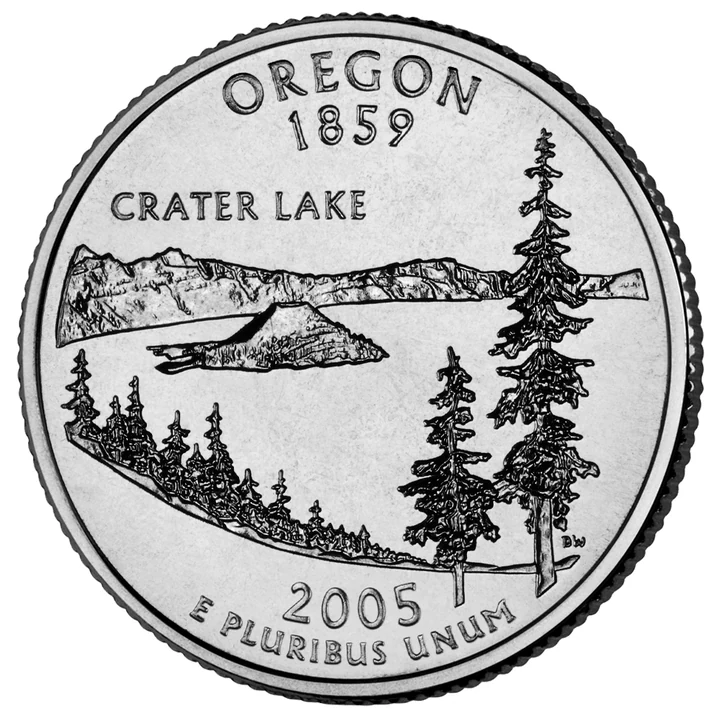
A south-southwest view across Crater Lake turns volcanic collapse, deep water, Wizard Island, and steep rim cliffs into Oregon's singular landscape emblem.
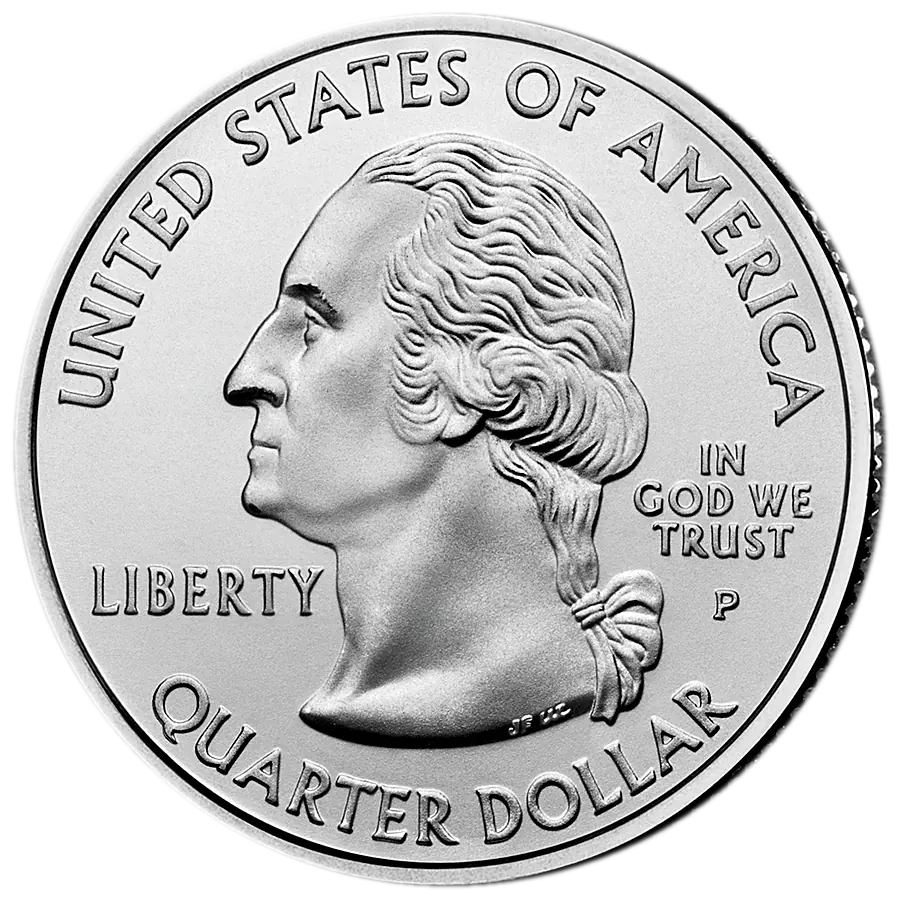
Exact Oregon reverse from the U.S. Mint; shared program obverse.
33 / 50release order
4mint/finish issues
P · D · Smint marks
2005release year
Story in 30 Seconds
The reverse is a named view of Crater Lake from the south-southwest rim. Wizard Island rises from the water; Watchman and Hillman Peaks form part of the caldera rim; steep cliffs and conifers frame CRATER LAKE beneath OREGON, 1859, 2005, and E PLURIBUS UNUM.
Oregon selected its only national park and the deepest lake in the United States as a place distinctive to the state. The scene compresses a 7,700-year-old volcanic caldera, precipitation-fed lake, and later cinder cone into one immediately recognizable natural identity.
The Oregon Commemorative Coin Commission recommended Crater Lake from four documented themes: Crater Lake, Chinook salmon, the Oregon Trail, and Mount Hood. Governor Ted Kulongoski accepted the recommendation; Treasury approved the design. CFA had preferred a simplified fish candidate, showing that federal advisers did not unanimously favor the issued subject.
Collectors distinguish P and D circulation strikes from S clad and 90% silver proofs. No major Oregon-specific variety is modeled in the canonical catalog; apparent extra islands, doubled cliffs, missing trees, or eruption marks require repeatable die evidence and are often ordinary strike weakness, die state, or damage.
Public Law 105-124 ordered state reverses by constitutional ratification or admission. Oregon entered the Union on February 14, 1859 as the thirty-third state, making this the program's thirty-third coin and third 2005 release. One reverse could not represent Oregon's Tribal nations, coast, Columbia River, Willamette Valley, high desert, forests, agriculture, fishing, migration, cities, labor, industry, or environmental conflicts. The issued design chose one protected volcanic landscape as a powerful but partial state identity.
Crater Lake occupies the caldera left when Mount Mazama erupted and collapsed about 7,700 years ago. Rain and snow filled the basin while post-caldera eruptions built Wizard Island and other submerged volcanoes. At a measured maximum of 1,949 feet, it is the deepest lake in the United States. The place is also a sacred homeland connected to Klamath and other Native peoples; the scenic national-park view does not contain those living relationships or the wider histories of dispossession and federal management.
The coin uses a real viewpoint rather than a generic lake. The Mint locates it on the south-southwest rim and names Wizard Island, Watchman Peak, and Hillman Peak. Low trees in the foreground establish the overlook; dark cliff bands enclose a smooth water field; the island sits off center beneath the explicit CRATER LAKE label.
The scene records two volcanic times at once. The surrounding caldera marks Mount Mazama's climactic eruption and collapse about 7,700 years ago. Wizard Island is a younger cinder cone built by eruptions as the basin filled. World Coin Book interprets island inside lake inside broken mountain as a compact sequence of destruction, renewal, and continuing geologic change; the Mint names the landscape but does not assign that moral meaning.
Depth and blue color cannot literally appear on an uncolored quarter. Weaver instead makes steep rim relief, broad open water, and a small island carry scale. The visual hierarchy moves from OREGON to cliffs and water, then to Wizard Island and CRATER LAKE. The island is not an impact crater, artificial monument, or remnant summit of Mount Mazama.
Selection made Crater Lake a claim of uniqueness: Oregon's only national park and a globally recognized volcanic lake could distinguish the state more narrowly than a broad trail, mountain, or fish theme. That choice also turned a protected federal landscape into a statewide emblem and visitor invitation.
The reverse emphasizes scenic wilderness, geology, depth, clarity, conifers, and public preservation. It leaves out the lake's Indigenous names and sacred relationships, Mount Mazama itself before collapse, underwater volcanoes and ecosystems, winter snow, park labor and access, climate change, and almost every populated, agricultural, coastal, riverine, and high-desert part of Oregon.
Oregon used an Oregon Commemorative Coin Commission to narrow the state's identity to four themes. The reviewed institutional account names Crater Lake, a jumping Chinook salmon, the Oregon Trail, and Mount Hood. It does not preserve the full solicitation notice, submission count, screening rubric, scores, or authors of every concept.
The Mint converted themes into coinable drawings for federal review. In February 2004 the Commission of Fine Arts preferred a variation of Oregon design 3 with one large fish centered on the coin. That recommendation was advisory; it demonstrates that the eventual Crater Lake result was not a unanimous federal design judgment.
The Oregon commission recommended Crater Lake to Governor Ted Kulongoski. Kulongoski endorsed it on May 24, 2004 and forwarded it as Oregon's selection. The reviewed official and institutional sources do not establish a binding statewide popular vote, poll totals, demographic reach, or legal weight, so the page does not invent public-ballot participation.
Treasury approved the Crater Lake design on July 13, 2004. The Mint credits Donna Weaver with both design and sculpture. The issued view specifies Wizard Island and named rim peaks; contemporary institutional reporting also notes refinement of trees, but a complete signed state recommendation, candidate gallery, advisory record, and model-to-die change log were not located.
Procedures varied by state and changed during the program; each researched state page must document its actual path.
Alternative Designs
Three documented alternatives competed with Crater Lake: a jumping Chinook salmon, the Oregon Trail, and Mount Hood. CFA preferred a simplified large-fish candidate, while the Oregon commission recommended Crater Lake and Kulongoski accepted that recommendation. No authenticated complete candidate-art gallery, submission corpus, public tally, or artist assignment for every alternative was located; World Coin Book therefore describes themes without reconstructing unseen designs.
Use the complete text cards below as the keyboard and screen-reader equivalent of the image.
Crater Lake and caldera water
Official explanation: The Mint identifies Crater Lake, viewed from the south-southwest rim, as the central subject and the deepest lake in the United States.
Historical context: The lake is filled chiefly by rain and snow inside Mount Mazama's collapse caldera; its measured maximum depth is 1,949 feet.
World Coin Book interpretation: A broad untextured field makes the water feel deep and still even though color and depth cannot be shown literally.
Official explanation: The Mint identifies Watchman and Hillman Peaks in the lake's rim and shows surrounding steep cliffs.
Historical context: The exposed walls preserve layers from Mount Mazama's long eruptive history and frame a basin formed by collapse, not meteor impact.
World Coin Book interpretation: The dark arc nearly encloses the water, turning the rim into both geological evidence and a protective visual frame.
Official explanation: The official scene includes trees on the rim but assigns no species, count, season, or symbolic meaning to them.
Historical context: Foreground trees establish the overlook while the distant rim compresses a five-by-six-mile caldera into shallow relief.
World Coin Book interpretation: Small trees against massive cliffs make human-scale vegetation the measure of geological scale without placing people on the coin.
CRATER LAKE · OREGON · 1859 · 2005 · E PLURIBUS UNUM · DW
Official explanation: The inscriptions name the place and state, admission and issue years, national motto, and Donna Weaver's initials as reverse designer and sculptor.
Historical context: The explicit place label prevents a small uncolored volcanic lake from becoming a generic mountain scene.
World Coin Book interpretation: CRATER LAKE anchors the open center while the rim chronology places the ancient landscape inside the federal sequence.
The deepest lake in the United States, occupying Mount Mazama's collapse caldera.
Wizard Island
A visible post-caldera cinder cone, mostly submerged beneath the lake.
Watchman and Hillman Peaks
Named rim features fixing the coin's south-southwest viewpoint.
Klamath and other Native peoples
Living peoples whose sacred relationships with the place predate the national park and are not visible on the reverse.
Oregon Commemorative Coin Commission
State body that recommended Crater Lake from four documented themes.
Ted Kulongoski
Governor who accepted the commission recommendation and forwarded Crater Lake.
Donna Weaver
U.S. Mint sculptor-engraver credited with both reverse design and sculpture.
Focused Timeline
Indigenous relationships
Caldera-forming eruption
Wizard Island
National park
Program authorization
Federal advisory review
Governor selection
Treasury approval
Release
State launch
Official Explanation and Interpretation
Artists and relief
John Flanagan's Washington portrait, adapted and sculpted for the program by William Cousins, appears on the shared obverse. Oregon's commission selected the Crater Lake theme, but the reviewed record does not identify the author of every initial concept or candidate drawing. The U.S. Mint credits Donna Weaver as both reverse designer and sculptor. That means she translated the approved subject into coinable composition and relief; it does not make the commission, governor, park staff, or public the die artist. The full drawing, model, hub, die, lettering, and production-change record remains unavailable.
P and D are circulation issues. Both S issues were sold in proof products; the silver proof is a distinct 90% silver composition. Mintages are established catalog figures retained with an explicit source-audit limit.
Identification Guide
Identify the reverse by CRATER LAKE across the water, Wizard Island below center, the dark enclosing caldera rim, foreground conifers, and OREGON above. P, D, or S appears on the obverse beside Washington's hair ribbon. P and D are circulation strikes; S issues are proofs. The clad proof has a copper-colored core stripe at the reeded edge and weighs 5.67 g; the 90% silver proof lacks that stripe and weighs about 6.25 g.
Condition Guide
Inspect Wizard Island's summit and slopes, the highest cliff ridges, thin tree tips and trunks, CRATER LAKE letters, and raised rim inscriptions. First wear dulls several exposed points and interrupts luster. Flat island texture, merged trees, or soft cliff layers that retain luster may be strike weakness, grease, polishing, or die state rather than circulation wear.
The broad lake field shows contact marks, scrapes, residue, and cleaning readily; dense cliff and tree relief can conceal hits. Proofs require checks for hairlines, haze, milk spots, fingerprints, frost breaks, and impaired mirrors. Judge strike, wear, surfaces, and any claimed die variety separately.
Mint Errors vs. Damage
The canonical Oregon catalog models no recognized major variety beyond the four normal mint-and-finish issues. A seller label such as 'extra island,' 'doubled Wizard Island,' 'missing trees,' or 'erupting volcano' is not a catalog attribution without a stable parent issue, repeatable die markers, and specialist documentation.
Genuine mint errors can include off-center strikes, broadstrikes, clips, wrong planchets, struck-through material, retained cuds, or substantial die cracks. Authentication depends on mint-made geometry, metal flow, weight, and repeatable die evidence, not resemblance to smoke, lava, boats, buildings, faces, or animals in the cliffs.
Weakly struck or grease-filled details may soften trees, peaks, CRATER LAKE letters, or Donna Weaver's initials. Machine doubling and die deterioration can flatten or shelf lettering and cliff lines. Those production effects are not automatically doubled dies, and the normal island is a volcanic cinder cone rather than an impact crater.
Scratches, gouges, dents, flattened rims, dryer damage, glue, corrosion, plating disturbance, polishing, paint, heat color, and deliberate engraving are post-mint damage. Claims that the coin predicts an eruption, hides a second island, depicts Mount Hood, or shows a secret person are unsupported without documented repeatable evidence.
Why Collectors Care
Durable value tiers
Ordinary worn P and D examples usually occupy the face-value design-set tier. Better circulation coins attract interest through full luster, a clean lake field, sharp Wizard Island, separated cliff strata and trees, complete CRATER LAKE lettering, and legible DW initials. Clad proofs form a collector-product tier; silver proofs add 90% silver as a separate composition tier. Unsupported novelty labels do not create a variety premium. World Coin Book gives no live price promise: compare dated completed transactions for the exact mint, finish, grade, and surfaces.
Official law and U.S. Mint records establish program facts and image identity. World Coin Book separates official explanation, historical analysis, and editorial interpretation.
Official descriptions, historical context, and World Coin Book interpretation are labeled separately. No live prices are asserted. Last verified:
The commission's creating instrument, complete roster, appointment record, charge, meetings, attendance, minutes, votes, minority views, and signed recommendation were not located in the reviewed official record.
The complete solicitation notice, submission form, eligibility rules, submission count, narrative corpus, screening rubric, scores, authors, and preservation location were not located.
No official evidence located for this stage establishes a statewide public vote, poll method, dates, totals, demographic reach, duplicate controls, result, or legal weight; public-ballot selection is not asserted.
Complete candidate artwork, Mint artist assignments, CCAC deliberations, state feedback, and a full change log from themes through drawing, model, lettering, hub, die, and issued relief remain unavailable.
The CFA record numbers Oregon designs and recommends a fish variation but does not map every number to all four state themes. This page does not guess those correspondences.
Official sources identify the viewpoint, Wizard Island, Watchman and Hillman Peaks, and Crater Lake, but do not name every cliff, tree species, tree count, snow condition, season, light direction, or symbolic meaning of each relief line.
Institutional reporting mentions tree refinements, but the precise before-and-after art and authorizing production record were not located; the page does not claim a complete revision history.
Normalized mintages remain established catalog figures; future work should attach direct Mint annual-production and proof-sales evidence for every issue.