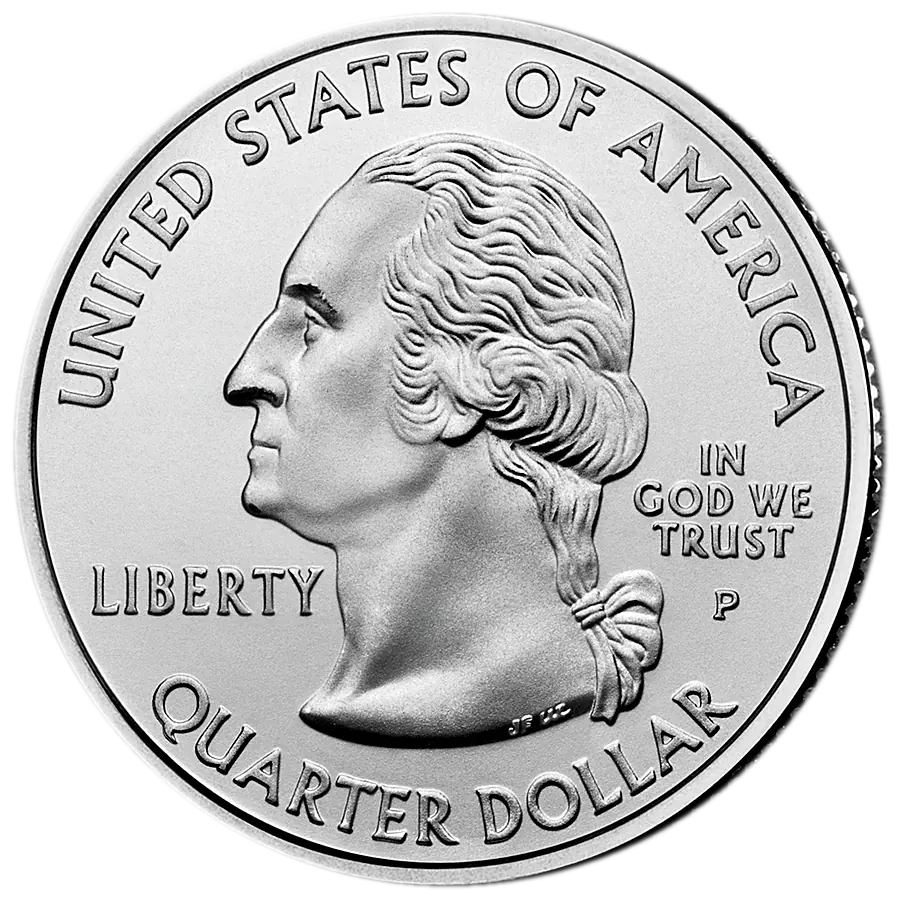
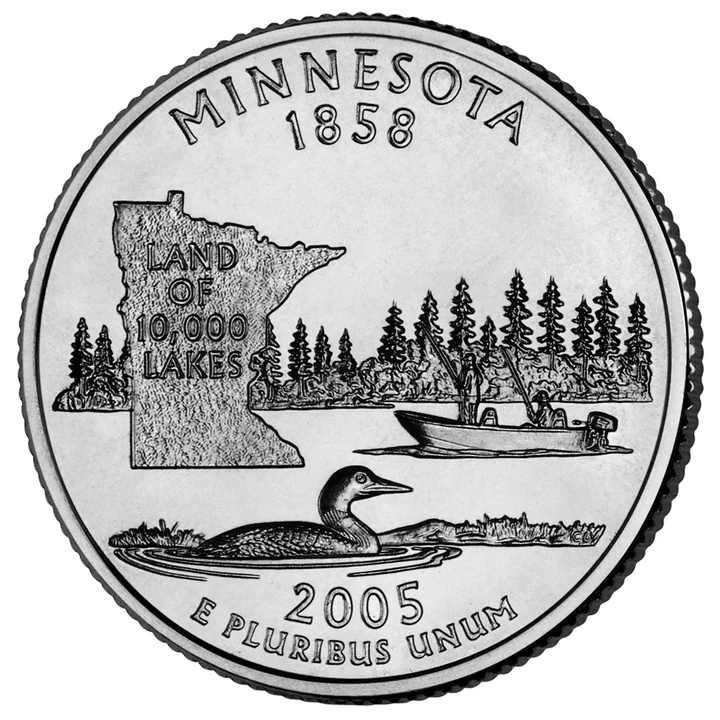
Exact Minnesota reverse from the U.S. Mint; shared program obverse.
32 / 50release order
4mint/finish issues
P · D · Smint marks
2005release year
Story in 30 Seconds
The reverse shows two people fishing from a small boat on a tree-lined lake, a common loon on the water, and a textured Minnesota outline around LAND OF 10,000 LAKES. MINNESOTA, 1858, 2005, and E PLURIBUS UNUM complete the federal frame.
Minnesota selected an immediately legible water-and-recreation identity. The lake and forest invoke the state's extensive inland waters, the anglers make human use central, the loon supplies the official state bird, and the map and nickname name the place directly.
Executive Order 03-07 created a commission to solicit written narratives, recommend up to five, obtain Treasury-approved designs, seek public comment, and advise Governor Tim Pawlenty. Four designs reached federal review; the commission recommended Land of 10,000 Lakes and Pawlenty selected it.
Collectors distinguish P and D circulation strikes from S clad and 90% silver proofs. The 2005-P FS-801 doubled-die reverse has a repeatable partial extra-tree diagnostic; shadows, scratches, machine doubling, die deterioration, and random marks are not automatically that variety.
Public Law 105-124 ordered state reverses by constitutional ratification or admission. Minnesota entered the Union on May 11, 1858 as the thirty-second state, making this the program's thirty-second coin and second 2005 release. One reverse could not represent Dakota and Ojibwe homelands, immigration, agriculture, mining, cities, industry, prairie, forest, rivers, wetlands, winter, arts, or political life. The issued design chose a recreational lake identity that was nationally recognizable but necessarily partial.
Minnesota's nickname is numerically conservative rather than exact: the Department of Natural Resources counts 11,842 lakes of ten acres or more, while definitions change totals. Water drains north toward Hudson Bay, east through the Great Lakes, and south through the Mississippi. The common loon, state bird since 1961, depends on clear freshwater for feeding and remains sensitive to disturbance and pollutants. These waters are also Dakota and Ojibwe homelands and living cultural landscapes, context the recreation-centered reverse does not show.
The composition works in layers. A textured state outline sits behind LAND OF 10,000 LAKES at left; a dense conifer shoreline spans the horizon; two anglers occupy a boat near center; a loon floats in open water at right. Map, habitat, people, and bird make the nickname visible rather than merely printing it.
The water is not identified as one named lake. That generic choice lets one scene stand for thousands of waters and for fishing as a statewide practice, but it removes the different geology, ecology, communities, treaties, economies, and access histories of actual lakes. The boat presents leisure, not commercial harvest or subsistence.
The loon is both emblem and ecological signal. Minnesota identifies the common loon as its state bird, and DNR monitoring connects loon success to clean water, shore conditions, disturbance, mercury, and lead. World Coin Book interprets the loon opposite the boat as a reminder that recreation shares habitat with wildlife; the Mint describes the elements but does not publish that exact environmental reading.
The outline and slogan occupy the left foreground while the boat and loon move the eye across the water. Repeated tree trunks create depth, but their crowded relief also generated the coin's best-known doubled-die discussion. The official image has many trees; a genuine FS-801 attribution depends on a specific repeatable doubled feature, not simply seeing one more line.
The design emphasizes abundance, quiet recreation, forested northern scenery, and a familiar bird. It leaves out Dakota and Ojibwe sovereignty and relationships to water, prairie and agricultural regions, cities and industry, mining, river transport, winter, uneven public access, shoreline development, water-quality threats, and lakes without postcard scenery.
Governor Tim Pawlenty's Executive Order 03-07 created the Governor's State Quarter Dollar Commission in May 2003. Seven governor-appointed seats represented a student, three public members, an American Numismatic Association member, a high-school social-studies teacher, and an elementary teacher; legislative appointees also participated and the Department of Education supplied staff.
The commission had to publish procedures, invite written design narratives, review them, and forward up to five finalists to the governor. The order emphasized school participation. After the governor sent narratives to the Mint, Mint artists—not state entrants—translated the written themes into coinable candidate art for Treasury and advisory review.
Four designs reached CFA in February 2004: State with Symbols (snowflake, plow, and loon over the outline), Mississippi River Headwaters, Fisherman/Lake Recreation, and Land of 10,000 Lakes. CFA favored the fourth and asked that it remain simple. The reviewed official trail does not preserve the complete submission corpus, exact count, screening scores, or authors of each narrative.
After Treasury approved the candidates, the commission was charged to seek public comment, possibly through a poll. The Mint says the commission recommended Land of 10,000 Lakes and Pawlenty chose that recommendation. The reviewed records do not establish the comment method, dates, totals, demographic reach, or legal weight, so this page does not call it a statewide popular vote.
The Secretary of the Treasury held final approval. The issued relief preserves the selected lake, anglers, loon, map, and nickname. The reviewed official sources do not provide a complete candidate-to-final change log for tree count, boat, figures, loon, map texture, lettering, models, hubs, dies, or production adjustments.
Procedures varied by state and changed during the program; each researched state page must document its actual path.
Alternative Designs
The three documented alternatives were State with Symbols—a snowflake, loon, and plow over the state outline—Mississippi River Headwaters, and Fisherman/Lake Recreation. Land of 10,000 Lakes was the fourth candidate and became the coin. CFA preferred it; the commission recommended it; Pawlenty selected it. No authenticated complete submission gallery, public-comment tally, or candidate artist assignments were located, so World Coin Book does not invent additional finalists or reconstruct unseen art.
Official explanation: The official description identifies a tree-lined lake, boat, anglers, and loon but assigns no meaning to individual trees, ripples, or directions.
Historical context: Minnesota includes prairie, deciduous forest, coniferous forest, rivers, wetlands, and urban waters beyond this northern-lake shorthand.
World Coin Book interpretation: Horizontal shoreline and ripples create calm depth; boat and loon distribute small living forms across the broad water field.
Official explanation: The inscriptions give the state, admission year, issue year, national motto, and Charles L. Vickers's initials as reverse designer and sculptor.
Historical context: The Mint credits Vickers with both translating the approved concept and sculpting its shallow relief.
World Coin Book interpretation: The rim chronology fixes a timeless-looking outing within the federal admission sequence and records Mint authorship.
A statewide water identity represented by a generic lake rather than one named place.
Common loon
Minnesota's official state bird, shown on the water and dependent on healthy freshwater habitat.
Dakota and Ojibwe peoples
Living Indigenous nations and water relationships absent from the recreation-centered reverse.
Governor's State Quarter Dollar Commission
State body that solicited narratives, reviewed candidates, sought comment, and advised the governor.
Tim Pawlenty
Governor who created the commission and selected its recommended Land of 10,000 Lakes design.
Charles L. Vickers
U.S. Mint artist officially credited as reverse designer and sculptor.
Focused Timeline
Dakota and Ojibwe relationships
Statehood
State bird
Program authorization
Commission created
Federal design review
State selection
Release
State launch
Official Explanation and Interpretation
Artists and relief
John Flanagan's Washington portrait, adapted and sculpted for the program by William Cousins, appears on the shared obverse. Minnesota participants supplied written narratives under rules that deliberately left visual translation to Mint artists. The U.S. Mint credits Charles L. Vickers as both reverse designer and sculptor. That credit covers the coinable composition and relief, not authorship of every public idea. The reviewed record does not identify each narrative submitter, candidate artist assignment, model revision, or production adjustment.
P and D are circulation issues. Both S issues were sold in proof products; the silver proof is a distinct 90% silver composition. Mintages are established catalog figures retained with an explicit source-audit limit.
Identification Guide
Identify the reverse by the textured Minnesota outline and LAND OF 10,000 LAKES at left, two anglers in a boat near center, a loon at right, and a forested shoreline. P, D, or S appears on the obverse beside Washington's hair ribbon. P and D are circulation strikes; S issues are proofs. The clad proof shows a copper-colored core at the reeded edge and weighs 5.67 g; the 90% silver proof lacks that stripe and weighs about 6.25 g.
Condition Guide
Inspect the anglers' heads and shoulders, boat rim, loon head and back, highest tree crowns and trunks, state-outline texture, and raised lettering. First wear dulls exposed points and breaks luster across more than one area. Soft faces, incomplete tree lines, weak map texture, or a flat loon that retains luster can reflect strike pressure, grease, or die state rather than circulation wear.
Broad water and map fields reveal contact marks, scrapes, residue, and cleaning. Dense trees can hide hits and make shadows or die deterioration look like extra branches. Proofs require checks for hairlines, haze, spots, fingerprints, frost breaks, and impaired mirrors. Grade strike, wear, surface preservation, and any doubled-die attribution separately.
Mint Errors vs. Damage
Recognized specialist variety: PCGS identifies the 2005-P FS-801 (DDR-001) doubled-tree reverse. Its diagnostic is a repeatable partial ghostlike tree with pronounced boughs beside a specific central tree. World Coin Book does not add a separate issue row because the current canonical catalog has no normalized variety record for it; collectors should use exact specialist diagnostics.
Other Minnesota doubled dies have been reported, but 'extra tree' is not one universal appearance or a guarantee of rarity. The normal reverse already contains overlapping trunks, branches, water lines, and map texture. Machine doubling, die deterioration, grease, lighting, image sharpening, and compression can imitate separation without the FS-801 die markers.
Genuine mint errors can include off-center strikes, broadstrikes, clips, wrong planchets, struck-through material, retained cuds, or substantial die cracks. Authentication requires mint-made geometry, metal flow, correct weight, and repeatable die evidence. A raised die crack differs from an incuse scratch crossing the trees or water.
Scratches, gouges, dents, flattened rims, dryer damage, glue, corrosion, plating disturbance, polishing, paint, and heat color are post-mint damage. Claims of extra boats, extra loons, doubled anglers, hidden fish, new islands, changed state borders, or a named secret lake are unsupported unless tied to a documented repeatable die or minting event.
Why Collectors Care
Durable value tiers
Ordinary worn P and D examples usually occupy the face-value design-set tier. Better circulation coins attract interest through full luster, clean water and map fields, distinct anglers and boat, a sharp loon, separated tree detail, clear map texture, and legible CLV. Clad proofs form a collector-product tier; silver proofs add 90% silver as a separate composition tier. A properly attributed FS-801 belongs to a specialist variety tier, but vague 'extra tree' claims do not. World Coin Book gives no live price promise: compare dated completed transactions for the exact mint, finish, grade, surfaces, and attribution.
Official law and U.S. Mint records establish program facts and image identity. World Coin Book separates official explanation, historical analysis, and editorial interpretation.
Official descriptions, historical context, and World Coin Book interpretation are labeled separately. No live prices are asserted. Last verified:
The complete narrative-submission corpus, exact count, submission form, eligibility details, preservation location, screening rubric, scores, and authors of the four advanced themes were not located in the reviewed official record.
The complete commission roster, legislative appointees, attendance, minutes, votes, minority views, staff work, and recommendation instrument were not located online beyond official agency summaries and required membership categories.
Executive Order 03-07 required public comment after Treasury approval and allowed but did not require a poll. The reviewed record does not establish method, dates, response total, demographic reach, duplicate controls, result, or legal weight; no statewide popular vote is asserted.
The signed governor-selection and Treasury final-approval instruments were not located. The Mint records that Pawlenty chose the commission recommendation and that Treasury held final approval.
Complete candidate artwork, Mint artist assignments, CCAC deliberations, state feedback, and the change log from written narrative through drawing, digital or plaster model, lettering, hub, die, and issued relief remain unavailable.
Official sources do not name the lake, tree species, boat type, anglers, fish species, season, time, direction, exact loon sex or age, or symbolic meaning of each ripple and tree. These details remain generic rather than clues to a secret location.
The state nickname is not a fixed scientific inventory. Lake totals depend on definitions; this page uses the DNR's stated ten-acre threshold and does not treat 10,000 as an exact claim.
FS-801 is acknowledged from a specialist grading source, but the current canonical catalog has no normalized variety row. A future catalog change should add one only with exact parent, identifiers, diagnostics, and publication review.
Normalized mintages remain established catalog figures; future work should attach direct Mint annual-production and proof-sales evidence.