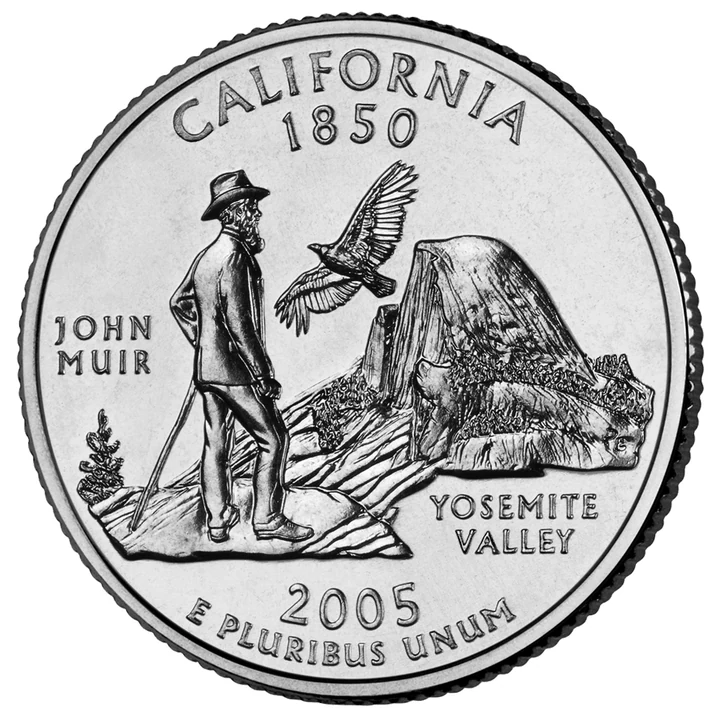
John Muir faces Half Dome while a California condor crosses the space between person and landscape—a conservation story made from both achievement and omission.
Exact California reverse from the U.S. Mint; shared program obverse.
31 / 50release order
4mint/finish issues
P · D · Smint marks
2005release year
Story in 30 Seconds
The reverse shows naturalist and conservationist John Muir facing Yosemite Valley's granite Half Dome while a California condor soars between them. CALIFORNIA, JOHN MUIR, YOSEMITE VALLEY, 1850, 2005, and E PLURIBUS UNUM identify state, person, place, admission, issue year, and national motto.
California selected a preservation-centered identity: Muir represents influential wilderness advocacy, Half Dome makes Yosemite immediately recognizable, and the condor represents an endangered species brought back from the brink through continuing cooperative recovery work.
A broad public call produced thousands of concepts. Twenty online-poll finalists were reduced by the State Librarian's office and 20-member commission to five concepts. Federal advisers preferred other designs, but Governor Arnold Schwarzenegger chose Muir/Yosemite and Treasury approved it on April 15, 2004.
Collectors distinguish P and D circulation strikes from S clad and 90% silver proofs. No recognized variety is modeled in the exact California issue set; scratches, machine doubling, weak relief, plating disturbance, and invented Half Dome or condor 'errors' remain damage or unverified claims.
Public Law 105-124 ordered state reverses by constitutional ratification or admission. California entered the Union on September 9, 1850 as the thirty-first state, making this the program's thirty-first coin and first 2005 release. A single reverse could not represent California's Indigenous nations, Spanish and Mexican periods, migration, agriculture, cities, labor, technology, arts, coast, deserts, forests, mountains, water conflicts, and extraordinary human diversity. The issued design chose a nationally legible conservation narrative rather than a complete state portrait.
Only a narrow slice of California is needed to decode the design. Yosemite's granite landscape was shaped over immense geological time and has been home to Indigenous peoples since time immemorial. Muir's writing and advocacy helped expand federal protection, but preservation history did not begin with him and did not erase displacement, contested management, Hetch Hetchy, or living Tribal relationships. The condor adds a modern recovery story whose gains depend on captive breeding, releases, monitoring, threat reduction, and many state, federal, Tribal, zoo, and nonprofit partners.
The reverse stages a line of sight. Muir stands at left with a walking staff, Half Dome rises at right, and the condor crosses the open sky between them. Person, place, and species become one compact argument for conservation.
Muir first reached Yosemite in 1868. His observation, writing, organizing, and political relationships helped build support for Yosemite National Park in 1890 and federal management of Yosemite Valley and Mariposa Grove in 1906. His unsuccessful campaign against the Hetch Hetchy dam also shows that his influence was substantial, not absolute.
Half Dome is not merely scenery. It is granite shaped by deep geologic processes, uplift, water, ice, weathering, and rockfall. Its asymmetric profile gives the coin a monumental right edge and lets a single landform stand for the larger Sierra Nevada and national-park idea.
The California condor makes the story contemporary. By the 1980s only about two dozen survived; all remaining wild birds entered captivity by 1987, followed by breeding and reintroduction. World Coin Book interprets its flight between Muir and Half Dome as a bridge from preservation ideals to active species recovery; the Mint identifies tribute to recovery but does not assign that exact compositional allegory.
The coin emphasizes iconic wilderness, a famous male advocate, and recovery success. It leaves out the First People of Yosemite, their continuing connections, violent displacement, working landscapes, cities, coast and desert, water and fire, environmental burdens, and the unresolved threats that make condor recovery ongoing rather than complete.
California's Quarter Project was run through the California State Library with the California Arts Council. A public call distributed through schools and libraries produced thousands of concepts; reviewed contemporary federal evidence says the governor's office sought broad input, then used an online poll to narrow 20 finalists.
The State Librarian's office and 20-member California State Quarter Commission reduced the field to the maximum five concepts. Governor Gray Davis forwarded them: a Gold Rush miner collage, Golden Gate Bridge collage, stylized waves and sun, John Muir looking toward Yosemite, and a giant sequoia. The reviewed official trail does not preserve the complete submission corpus, exact poll totals, scoring, or issued concept's original submitter identity.
The Mint converted concepts into coinable candidate art and sent five designs to federal review in November 2003. CFA thought the Muir design promising but too busy and preferred the Golden Gate Bridge after removing incorrectly scaled palms and sequoias. CCAC preferred stylized waves and sun and ranked Muir/Yosemite second.
A gubernatorial transition occurred between submission and final choice. Governor Arnold Schwarzenegger selected the John Muir/Yosemite Valley concept from the five presented by the commission. The California State Library records that Treasury approved it on April 15, 2004.
The issued design was not identical to the reviewed candidate. CCAC's annual report states that the final variant enlarged Muir and moved Half Dome farther away. The reviewed sources do not preserve every Mint sketch, state comment, digital or plaster model, inscription move, relief reduction, hub, die, or production adjustment.
Procedures varied by state and changed during the program; each researched state page must document its actual path.
Alternative Designs
The five documented concepts were a Gold Rush miner collage, a Golden Gate Bridge collage, stylized waves and sun, John Muir with Yosemite, and a giant sequoia. CFA preferred the bridge with trees removed; CCAC preferred waves and sun and placed Muir second. California ultimately chose Muir/Yosemite. Earlier online voting involved 20 finalists, but the reviewed official record does not preserve all names, images, vote totals, or rejection reasons, so World Coin Book does not reconstruct them from memory or substitute later summaries as complete evidence.
Use the complete text cards below as the keyboard and screen-reader equivalent of the image.
John Muir and walking staff
Official explanation: The Mint identifies Muir as the naturalist and conservationist admiring Yosemite Valley.
Historical context: His writing and advocacy supported Yosemite protection, while his Hetch Hetchy campaign failed and his viewpoint does not encompass Yosemite's full human history.
World Coin Book interpretation: The small standing figure supplies a human witness and directs the eye toward the mountain rather than dominating it.
Official explanation: The Mint describes the soaring condor as a tribute to successful repopulation of a bird once nearly extinct.
Historical context: Recovery required capture, captive breeding, releases, monitoring, threat reduction, and continuing multi-partner work; it is not a completed rescue.
World Coin Book interpretation: The bird crosses the central void, visually joining the historical advocate to a living conservation challenge.
Official explanation: The inscriptions explicitly identify the represented person and place.
Historical context: The place label does not name Half Dome, Ahwahnee, the First People of Yosemite, or a literal viewpoint.
World Coin Book interpretation: Two horizontal labels stabilize the irregular landscape and prevent the tiny figure and distant profile from becoming generic.
CALIFORNIA · 1850 · 2005 · E PLURIBUS UNUM · AM · DE
Official explanation: The inscriptions give state, admission year, issue year, national motto, and the initials of designer Alfred Maletsky and sculptor Don Everhart.
Historical context: The Mint separately credits Maletsky for design and Everhart for sculpting the reverse relief.
World Coin Book interpretation: The rim chronology fixes the image within federal sequence while the artist initials preserve the concept-to-relief division of labor.
Writer, naturalist, organizer, and conservation advocate shown facing Half Dome.
Yosemite Valley and Half Dome
Granite landscape used as the coin's compact emblem of California wilderness and preservation.
First People of Yosemite
Indigenous peoples with ancient and continuing connections to Yosemite, absent from the reverse.
California condor
Endangered North American land bird represented in flight and dependent on continuing recovery work.
California State Quarter Commission
Twenty-member state body that reduced public concepts to five for gubernatorial and federal review.
Arnold Schwarzenegger
Governor who selected the Muir/Yosemite concept after Gray Davis had forwarded the five candidates.
Alfred Maletsky and Don Everhart
Mint artists credited respectively with reverse design and sculpture.
Focused Timeline
First People of Yosemite
Muir reaches Yosemite
National park
Sierra Club
Federal management
Hetch Hetchy
Endangered listing
Captive flock
Program authorization
Public and federal review
Treasury approval
Release
Official Explanation and Interpretation
Artists and relief
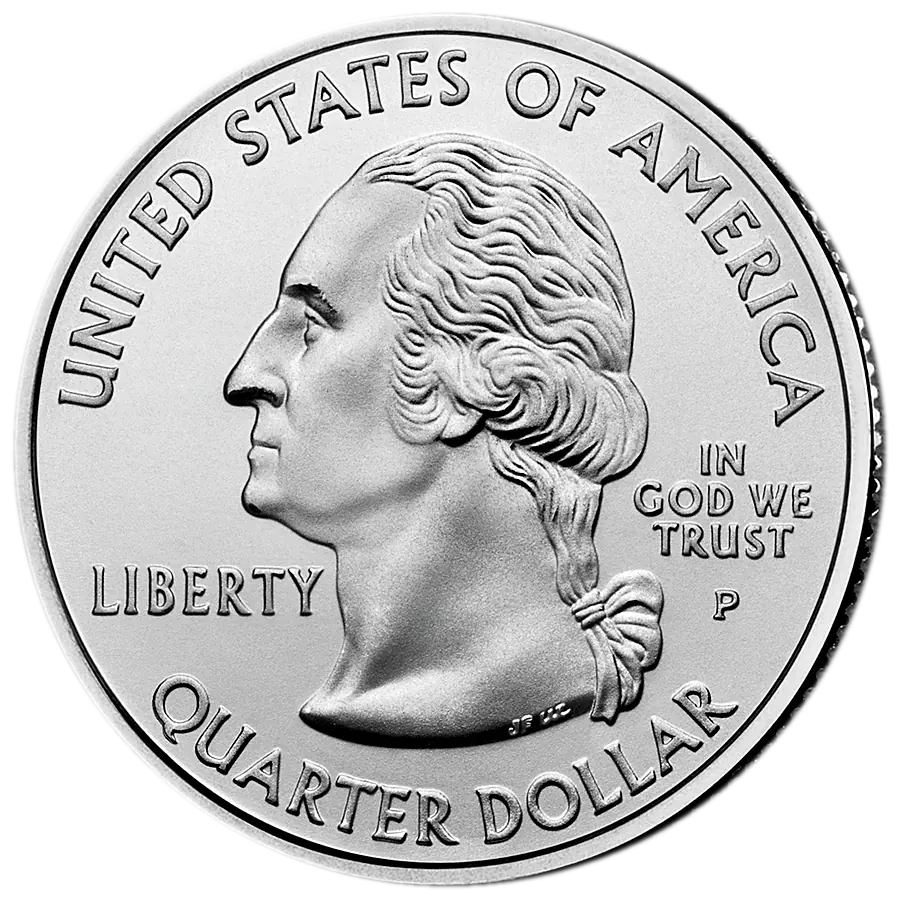
John Flanagan's Washington portrait, adapted and sculpted for the program by William Cousins, appears on the shared obverse. California's public process supplied the Muir/Yosemite concept, but the reviewed official record does not identify its original public submitter. The Mint credits Alfred Maletsky as reverse designer and Don Everhart as reverse sculptor. CCAC documents at least one production refinement: Muir became larger and Half Dome more distant. The complete sketch-to-relief, lettering, model, hub, die, and production record remains unavailable.
P and D are circulation issues. Both S issues were sold in proof products; the silver proof is a distinct 90% silver composition. Mintages are established catalog figures retained with an explicit source-audit limit.
Identification Guide
Identify the reverse by Muir with a walking staff at left, Half Dome at right, a condor overhead, and the explicit JOHN MUIR and YOSEMITE VALLEY inscriptions. P, D, or S appears on the obverse beside Washington's hair ribbon. P and D are circulation strikes; S issues are proofs. The clad proof normally shows a copper-colored core at the reeded edge and weighs 5.67 g; the 90% silver proof lacks that stripe and weighs about 6.25 g.
Condition Guide
Inspect Muir's head, shoulder, coat, hands, and staff; the condor's wings and body; Half Dome's crest and face; foreground contours; fine labels; and AM/DE initials. First wear dulls exposed relief and interrupts luster. A soft condor, weak staff, or flat mountain texture that retains luster can reflect strike or die state rather than wear.
Open sky and fields around Muir and the inscriptions reveal contact marks, scrapes, residue, and cleaning. The condor, staff, small lettering, and artist initials are vulnerable to weakness or hits. Proofs should be checked for hairlines, haze, spots, fingerprints, frost breaks, and diminished cameo. Judge strike, wear, and damage separately.
Mint Errors vs. Damage
Recognized catalog varieties: none are modeled in the current exact four-issue California set. This evidence boundary does not prove that no die states or specialist attributions exist, but it prevents unsourced internet labels from becoming catalog varieties.
Genuine mint errors can include off-center strikes, broadstrikes, clips, wrong planchets, struck-through material, retained cuds, or substantial die cracks. Authentication requires mint-made geometry, metal flow, weight, and repeatable diagnostics—not resemblance to a mountain, bird, face, letter, or online nickname.
Shelf-like doubling on CALIFORNIA, JOHN MUIR, YOSEMITE VALLEY, dates, AM, or DE is often mechanical doubling or die deterioration, not a doubled die. Weak strike, grease, glare, image compression, wear, and small die chips can create alleged extra condors, missing staffs, changed faces, mountain cracks, waterfalls, or doubled inscriptions without establishing a recognized variety.
Scratches, gouges, dents, flattened or rolled rims, dryer damage, glue, corrosion, plating bubbles, polishing, paint, and heat color are post-mint damage. A scratch across Half Dome is not proof of an earthquake, rockfall, climbing route, or secret map; the bird is a California condor, not an eagle, hawk, or turkey vulture, and the official design shows one condor rather than a coded flock.
Why Collectors Care
Durable value tiers
Ordinary worn P and D examples usually occupy the face-value design-set tier. Better circulation coins attract interest through full luster, clean sky and mountain fields, a distinct Muir profile and staff, complete condor wings, sharp Half Dome contours, legible place labels, and clear AM/DE. Clad proofs form a collector-product tier; silver proofs add 90% silver as a separate composition tier. With no recognized variety modeled here, condition and exact finish—not viral labels—drive durable tiers. World Coin Book gives no live price promise: compare dated references and completed transactions for the exact mint, finish, grade, strike, and surfaces.
Official law and U.S. Mint records establish program facts and image identity. World Coin Book separates official explanation, historical analysis, and editorial interpretation.
Official descriptions, historical context, and World Coin Book interpretation are labeled separately. No live prices are asserted. Last verified:
The creating order or charter for the 20-member California State Quarter Commission, complete roster and appointment records, administrative rules, budget record, original submission form, eligibility terms, and meeting minutes were not located in the reviewed official online trail.
The complete public submission corpus, exact total, submitter demographics, preservation location, screening rubric, 20 online finalists, publication-quality images, poll dates, vote totals, duplicate-vote controls, and legal weight remain unavailable from reviewed official sources.
The original submitter or submitters of the issued Muir/Yosemite concept and every contribution by California State Library, California Arts Council, commission, governor staff, and Mint artists are not resolved; official artist credit begins with Maletsky and Everhart on the coin design and relief.
The complete five candidate images, their Mint artist assignments, all state feedback, and every CFA and CCAC comment were not located at publication quality. The reviewed record identifies the five themes and advisory preferences without reconstructing unseen layouts.
The governor's signed selection instrument and Treasury's April 15, 2004 approval instrument were not located; the date and action are preserved in the California State Library's official state-symbol record.
The complete candidate-to-issued change log remains unavailable. CCAC documents larger Muir and more distant Half Dome, but exact sketch, model, lettering, relief, hub, die, and production changes are unresolved.
Official sources do not identify Muir's exact pose source, clothing, staff, literal viewpoint, precise condor age or sex, flight direction, Half Dome face or trail, every foreground feature, or a symbolic meaning for each relief line.
The coin's recovery language must not imply that condor recovery is complete. Population counts and threats change; this page uses durable history and leaves current status to dated U.S. Fish and Wildlife Service reports.
Normalized mintages remain established catalog figures; future work should attach direct Mint annual-production and proof-sales evidence.