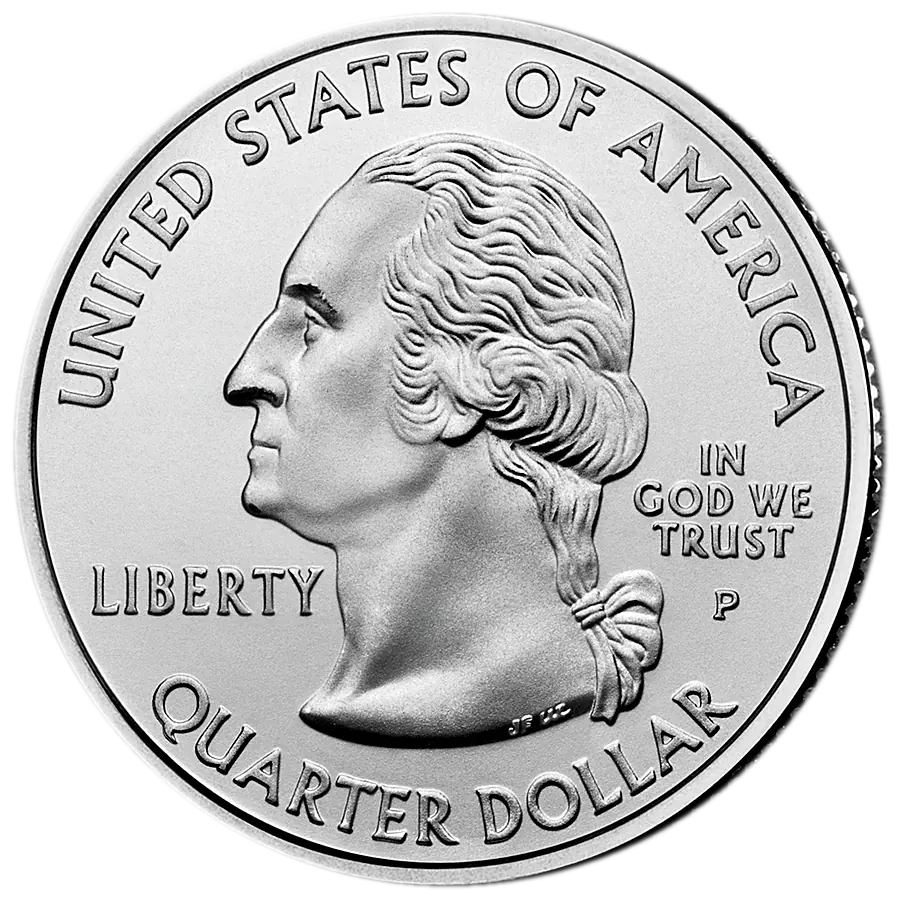
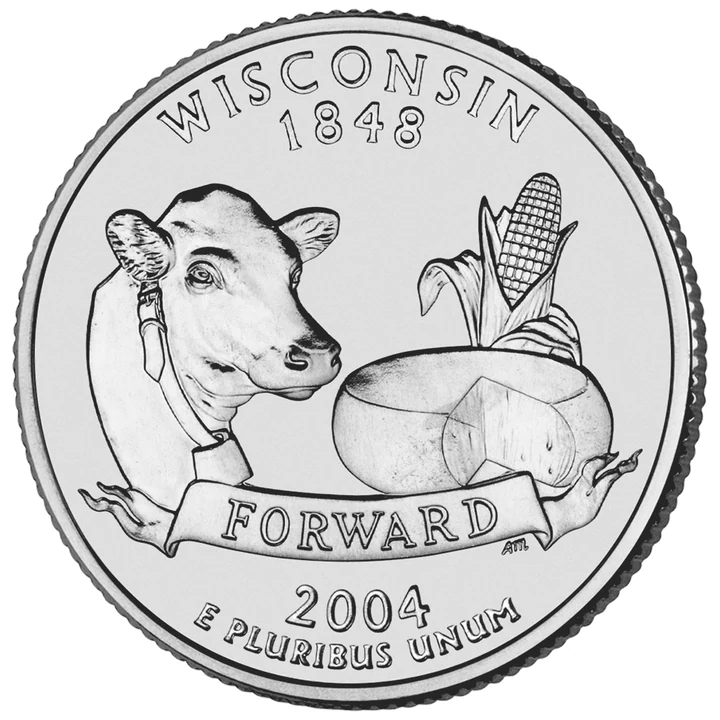
A cow, cheese wheel, and ear of corn turn Wisconsin's agricultural economy into a compact emblem, while Forward insists that identity is not only about looking back.
Exact Wisconsin reverse from the U.S. Mint; shared program obverse.
30 / 50release order
4mint/finish issues
P · D · Smint marks
2004release year
Story in 30 Seconds
The reverse shows a cow's head, a round of cheese, an ear of corn, and a banner reading FORWARD, with WISCONSIN, 1848, 2004, and E PLURIBUS UNUM around the rim.
The Mint describes an agricultural theme: cattle and cheese evoke America's Dairyland, while corn represents another major crop. Forward is Wisconsin's state motto, adopted in 1851.
Governor Scott McCallum created a 23-member council. More than 9,000 resident suggestions became six semifinalists and three themes; after Mint review, three finalists went to a 347,662-vote public poll. Agriculture won the public vote, early exploration won the council's final vote, and Governor Jim Doyle chose agriculture because of public support.
Collectors distinguish P and D circulation strikes, S clad and 90% silver proofs, and the recognized 2004-D Extra Leaf High and Extra Leaf Low varieties. Damage and ordinary marks near the corn must not be promoted into those varieties.
Public Law 105-124 ordered state reverses by constitutional ratification or admission. Wisconsin entered the Union on May 29, 1848 as the thirtieth state, so its quarter became the program's thirtieth coin and fifth 2004 release. One reverse could not represent Wisconsin's Indigenous nations, Great Lakes, forests, mining, immigration, cities, labor, industry, recreation, arts, and every community. The issued design chose an immediately legible agricultural identity and the forward-looking state motto rather than a complete state portrait.
Wisconsin's farm identity was made, not timeless. University of Wisconsin history records a late-nineteenth-century transition from wheat toward dairying, supported by agricultural education, winter feed systems, breeding, and the Babcock butterfat test. Corn belongs to that connected system as grain and cattle feed as well as a crop in its own right. The quarter celebrates production and food without showing farm labor, environmental costs, consolidation, Indigenous land loss, changing rural communities, or the state's urban and industrial life.
The design works as a three-part chain. A cow supplies milk; cheese turns milk into a durable, skilled product; corn links the field to both food and livestock feed. The objects are not a literal farm scene but a compact agricultural emblem.
The cow dominates the upper field and looks inward. Cheese occupies the low center, while the corn rises diagonally at right. Their overlapping scale sacrifices realism for instant recognition in shallow relief.
Official sources connect the design to Wisconsin's milk, cheese, and corn production. World Coin Book reads the three objects as land, animal, and processed food joined in one economy; that relationship is editorial interpretation, not a separate allegory assigned by the Mint.
FORWARD complicates the otherwise retrospective emblem. The motto was adopted in 1851 and presents progress as part of state identity, but the coin does not define whose progress, at what cost, or toward what future.
The design's familiarity helped it win the public poll and also fueled criticism that Wisconsin had been reduced to cows and cheese. That tension is part of the coin's story: a quarter must be readable at a glance, but recognition can harden one sector into a stereotype.
Governor Scott McCallum's Executive Order 27 of September 20, 2001 established the 23-member Wisconsin Commemorative Quarter Council and assigned the Department of Financial Institutions to administer a statewide process. The reviewed institutional history records more than 9,000 citizen suggestions.
The council grouped proposals into agriculture, scenic Wisconsin, and early exploration, selected six semifinalists, and used an initial public preference process to advance themes and submissions. Complete ballots, eligibility controls, and the entire submission corpus are not preserved in the reviewed online primary trail.
Five candidate designs reached federal review: two agricultural, one scenic, and two cultural-interaction designs. CFA found none fully successful and preferred simplified cultural-interaction treatments. CCAC favored a French explorer meeting a Native American and requested removal of several details. The Treasury Secretary approved all five.
Governor Jim Doyle selected three finalists: Donald Henning's scenic deer, muskie, pines, and distant farm; Bob Frankowiak's fur trader and Native American trading scene; and the cow, cheese, and corn agriculture design jointly submitted by Historic Cheesemaking Center, Inc. and Rose Marty. A September 2003 online poll drew 347,662 votes: agriculture 137,745 (about 40%), exploration 112,907 (about 32%), scenic 97,010 (about 28%).
Nineteen council members first split 9–8–2 for exploration, agriculture, and scenic. In a final two-way vote, exploration beat agriculture 13–8. Governor Doyle nevertheless selected Agriculture and Dairy on September 30, citing public support. CCAC records that Wisconsin then submitted it for final approval; the reviewed trail does not include the final Treasury instrument or complete Mint model-change record.
Procedures varied by state and changed during the program; each researched state page must document its actual path.
Alternative Designs
The six state semifinalists are documented by theme, but the reviewed source does not reproduce every design at publication quality. Federal review considered five candidates: two agriculture designs, one scenic design, and two cultural-interaction designs. The three public finalists were Donald Henning's deer-and-muskie scenic scene, Bob Frankowiak's fur-trade encounter, and the issued agriculture concept by Historic Cheesemaking Center, Inc. and Rose Marty. CFA and CCAC preferred cultural interaction; the council finally preferred exploration; the public and governor preferred agriculture. World Coin Book does not invent omitted layouts or identities for unnamed entrants.
Official explanation: The Mint identifies Forward as Wisconsin's state motto, adopted in 1851.
Historical context: The motto adds a civic statement to an economic emblem.
World Coin Book interpretation: The curved banner crowns the devices and asks the agricultural identity to signify continuing ambition, not only heritage.
The connected dairy, cheesemaking, and corn economy represented by the reverse.
Wisconsin Commemorative Quarter Council
Twenty-three-member advisory body that reviewed submissions and recommended early exploration.
Historic Cheesemaking Center, Inc. and Rose Marty
Joint submitters credited for the issued agriculture concept.
Jim Doyle
Governor who selected Agriculture and Dairy after considering public support.
Alfred Maletsky
U.S. Mint artist credited with designing and sculpting the issued reverse.
Forward
Wisconsin state motto appearing above the agricultural devices.
Focused Timeline
Statehood
Forward
Babcock test
Program authorization
State process
Public submissions
Federal review
Public vote
Governor selection
Release and launch
Official Explanation and Interpretation
Artists and relief
John Flanagan's Washington portrait, adapted and sculpted for the program by William Cousins, appears on the shared obverse. Historic Cheesemaking Center, Inc. and Rose Marty jointly submitted the cow, cheese, and corn concept. The Mint credits Alfred Maletsky as reverse designer and sculptor. Federal records show that Wisconsin supplied finished artwork during a transitional process, but the reviewed sources do not preserve every handoff, revision, relief reduction, inscription adjustment, model, hub, or die change between submission and issue.
P and D are circulation issues. Both S issues were sold in proof products; the silver proof is a distinct 90% silver composition. Mintages are established catalog figures retained with an explicit source-audit limit.
Identification Guide
Identify the reverse by the cow, cheese wheel, corn ear, and FORWARD. P, D, or S appears on the obverse beside Washington's hair ribbon. P and D are circulation strikes; S issues are proofs. The clad proof normally shows a copper-colored core at the reeded edge and weighs 5.67 g; the 90% silver proof lacks that stripe and weighs about 6.25 g.
Condition Guide
Inspect the cow's forehead, muzzle, ear, and neck; cheese rim and face; corn kernels, husk, stalk, and leaves; banner folds; lettering; and AM. First wear dulls exposed relief and interrupts luster. Flat kernels or soft fur that retain luster may be strike or die-state weakness rather than wear.
Broad open fields around the cow and banner reveal contact marks, scrapes, residue, and cleaning. Proofs should be checked for hairlines, haze, spots, fingerprints, frost breaks, and reduced cameo. For Extra Leaf attribution, examine only 2004-D coins and compare the raised High or Low leaf-like feature at the lower-left corn area with authenticated references; scratches, gouges, die chips, and glare are not substitutes.
Mint Errors vs. Damage
Recognized varieties: 2004-D Extra Leaf High and 2004-D Extra Leaf Low add distinct raised leaf-like features beside the lower-left corn leaf. They are Denver circulation-strike varieties, not normal details on every Wisconsin quarter and not S proofs.
The varieties are often called errors, but their exact die-making cause and intent remain debated. World Coin Book labels the observable, repeatable die varieties without asserting an unproved accidental gouge, deliberate act, or individual responsible.
Genuine mint errors can include off-center strikes, broadstrikes, clips, wrong planchets, struck-through material, retained cuds, or major die cracks. A normal P coin, proof, scratch, ding, glue ridge, corrosion blister, plating bubble, or random die chip near the corn is not an Extra Leaf High or Low.
Mechanical doubling, die deterioration, grease, weak strike, glare, image compression, wear, and impacts can produce alleged extra kernels, horns, cow eyes, cheese cuts, banner folds, doubled FORWARD, or altered AM. Post-mint scratches, dents, dryer damage, corrosion, polishing, plating, paint, and heat color are damage. The animal is officially only a cow's head; reviewed official sources do not identify a breed, named cow, cheese variety, corn cultivar, farm, or exact landscape.
Why Collectors Care
Durable value tiers
Ordinary worn P and D examples usually occupy the face-value design-set tier. Better circulation coins attract interest through luster, clean fields, a distinct cow face, complete cheese rim, crisp corn kernels and leaves, sharp banner, clear inscriptions, and visible AM. Clad proofs form a collector-product tier; silver proofs add 90% silver as a separate composition tier. Authenticated 2004-D Extra Leaf High and Low varieties form a specialist tier whose value depends on attribution, grade, and surfaces. World Coin Book gives no live price promise: compare dated references and completed transactions for the exact mint, finish, variety, grade, and condition.
Official law and U.S. Mint records establish program facts and image identity. World Coin Book separates official explanation, historical analysis, and editorial interpretation.
Official descriptions, historical context, and World Coin Book interpretation are labeled separately. No live prices are asserted. Last verified:
Executive Order 27, the council's appointment records, complete membership file, administrative rules, original submission form, eligibility controls, and every meeting minute were not located as standalone primary online records; the institutional history supplies the reviewed account.
The complete corpus of more than 9,000 suggestions, submitter demographics, preservation location, exact screening scores, six semifinalist images, and all rejection reasons remain unavailable.
The first public-preference stage is described in the institutional history, but its complete ballot, dates, vote totals, fraud controls, and legal effect were not located; the later three-finalist poll is documented with exact totals.
Complete publication-quality images and Mint artist assignments for all five federal candidates, all state feedback, and every CFA and CCAC comment were not located.
The final Treasury approval instrument for Agriculture and Dairy and the complete submitted-art-to-Maletsky-relief change log, including model, inscription, hub, die, and production revisions, remain unresolved.
Reviewed official sources do not identify the cow's breed or name, cheese type, corn cultivar, specific farm, exact viewpoint, or a separate meaning for each kernel, hair, rind line, banner fold, and background mark.
The exact origin and die-making mechanism of the 2004-D Extra Leaf High and Low varieties remains disputed; no reviewed primary Mint finding assigns intent or responsibility.
Normalized mintages remain established catalog figures; future work should attach direct Mint annual-production and proof-sales evidence.