A teacher and pupils plant a tree beside a one-room schoolhouse, adapting Grant Wood's Arbor Day into a compact statement about education and work across generations.
Exact Iowa reverse from the U.S. Mint; shared program obverse.
29 / 50release order
4mint/finish issues
P · D · Smint marks
2004release year
Story in 30 Seconds
The reverse shows a one-room schoolhouse, a teacher and pupils planting a sapling, rolling ground, and the inscriptions FOUNDATION IN EDUCATION and GRANT WOOD.
The Mint says the design is based on Grant Wood's 1932 painting Arbor Day. The scene joins rural schooling to a tree planted for the future, presenting education as patient community work.
Governor Thomas J. Vilsack created a 13-member committee and invited statewide citizen concepts. Five Mint designs represented Foundation in Education, Young Corn, and Feeding the World; reviewed records do not preserve the final state ranking or approval instrument that displaced the CFA's Feeding the World preference.
Collectors should distinguish P and D circulation strikes, S clad proof, and S 90% silver proof. The figures, sapling, schoolhouse roof and steps, hillside lines, inscriptions, and JM initials are the main diagnostic zones.
Public Law 105-124 ordered state reverses by constitutional ratification or admission. Iowa entered the Union on December 28, 1846 as the twenty-ninth state, so its quarter became the program's twenty-ninth coin and fourth 2004 release. One reverse could not represent Iowa's Indigenous nations, rivers and prairies, territorial change, agriculture, industry, migration, cities, civil rights, arts, schools, and every community. The issued design chose a rural education scene tied to one Iowa artist rather than a comprehensive state portrait.
Iowa's rural schools predated statehood, and the Mint notes that high schools and public and private colleges followed during the nineteenth century. Grant Wood was born near Anamosa, attended a one-room school, taught art, and turned remembered Iowa landscapes and communities into art that can be affectionate, constructed, and more complex than simple nostalgia. The quarter elevates schooling, collective labor, and future growth while omitting unequal access, school consolidation, Indigenous dispossession, agricultural change, cities, and the breadth of modern Iowa.
The design does not reproduce Arbor Day as a miniature painting. John Mercanti reduced Wood's larger landscape to a schoolhouse, teacher, pupils, sapling, shovel work, and layered ground that could survive in shallow relief.
Wood's 1932 Arbor Day looked back toward a rural school community planting trees. University of Iowa institutional research describes it as a tribute to pioneering teachers and a grove established over successive Arbor Days; related imagery later appeared in Tree Planting Group.
The sapling is literal before it is metaphorical: people are planting a tree. The issued inscription FOUNDATION IN EDUCATION invites a second reading in which teaching, like planting, creates conditions whose results appear later.
World Coin Book reads the teacher and pupils arranged around the young tree as a chain of knowledge and stewardship across generations. That is editorial interpretation; official sources identify education, the schoolhouse, the planting scene, Wood, and Arbor Day but do not assign a separate allegory to every figure or hill.
The reverse selects an idealized rural scene. It says little about Iowa's cities, Native nations, racial and economic conflict, mechanized agriculture, industry, or contemporary schools. Its power comes from a legible shared action, not documentary completeness.
Early legislative proposals competed over representation: Senate Concurrent Resolution 29 urged a commission and an Iowa State Capitol design, but that concept was not issued. Governor Vilsack's June 21, 2002 Executive Order 26 instead established the controlling public process.
The order created a 13-member Commemorative Quarter Committee chaired by Treasurer Michael Fitzgerald and Cultural Affairs Director Anita Walker, with the governor's designee, two numismatists, a student, teacher, artist, and eight citizens at large. Iowans could submit concepts postmarked by July 30, 2002.
The committee had to review citizen submissions under federal guidelines and recommend five ideas by August 25; the governor's office could send up to five to the Mint by August 27. Reviewed records do not supply the submission total, full corpus, meeting minutes, scoring, five state recommendations, or Governor Vilsack's ranking.
At the May 15, 2003 CFA review, five Mint designs expressed three concepts: Foundation in Education after a Wood schoolhouse scene, Young Corn after another Wood painting, and three Feeding the World treatments with crops, animals, and the state outline. The state was reported to embrace all five equally.
The CFA judged the Wood translations weak and preferred Feeding the World design 5, requesting typography and crop-detail changes. The issued design instead used Foundation in Education. The reviewed primary trail does not preserve the CCAC recommendation, governor's final preference, Treasury approval record, or exact reasons the schoolhouse prevailed.
Procedures varied by state and changed during the program; each researched state page must document its actual path.
Alternative Designs
Five federal designs are documented, though complete art is not preserved in the reviewed sources. One interpreted Foundation in Education as a schoolhouse with teacher and pupils; one adapted Wood's bird's-eye cornfield painting Young Corn; three interpreted Feeding the World with farm animals, corn, soybeans, and an Iowa outline. CFA preferred design 5, with cow and pig centered before the outline and crops at the sides. An earlier legislative proposal urged the Iowa State Capitol. World Coin Book does not invent missing submitters, rankings, vote totals, or layouts.
Official explanation: The inscriptions give state, admission year, issue year, national motto, and John Mercanti's initials.
Historical context: The Mint credits Mercanti as reverse designer and sculptor.
World Coin Book interpretation: Rim chronology locates the state in the program while JM records the artist who converted the selected concept to relief.
Iowa-born artist whose 1932 Arbor Day supplied the issued scene.
Arbor Day
Wood painting of a rural school community planting a tree.
One-room schoolhouse
Rural school building that anchors the reverse.
Commemorative Quarter Committee
Thirteen-member state body that reviewed citizen concepts and recommended five ideas.
John Mercanti
U.S. Mint artist credited with designing and sculpting the issued reverse.
Thomas J. Vilsack
Governor who established Iowa's selection process.
Focused Timeline
Statehood
Grant Wood born
One-room schooling
Arbor Day
Program authorization
State process
Submission deadline
Federal advisory review
Release
Launch
Official Explanation and Interpretation
Artists and relief
John Flanagan's Washington portrait, adapted and sculpted for the program by William Cousins, appears on the shared obverse. Grant Wood created Arbor Day in 1932; the coin credits him by name as the source artist, not as its medallic designer. The Mint credits John Mercanti as reverse designer and sculptor. Mercanti simplified the painting's architecture, figures, sapling, ground, and patterned landscape into shallow relief. Reviewed records do not preserve every change from Wood's painting through the Foundation in Education concept and Mint model to the issued die.
P and D are circulation issues. Both S issues were sold in proof products; the silver proof is a distinct 90% silver composition. Mintages are established catalog figures retained with an explicit source-audit limit.
Identification Guide
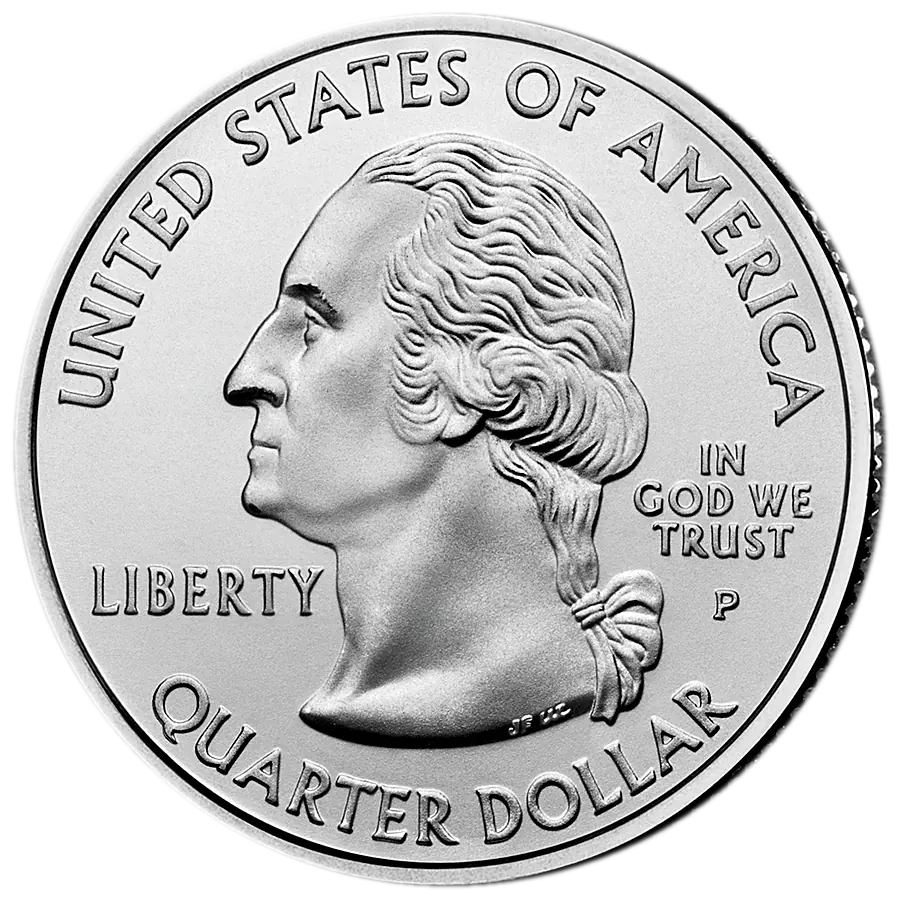
Identify the reverse by the one-room schoolhouse, teacher and pupils planting a sapling, FOUNDATION IN EDUCATION, and GRANT WOOD. P, D, or S appears on the obverse beside Washington's hair ribbon. P and D are circulation strikes; S issues are proofs. The clad proof normally shows a copper-colored core at the reeded edge and weighs 5.67 g; the 90% silver proof lacks that stripe and weighs about 6.25 g.
Condition Guide
Inspect heads and shoulders, sapling and branches, shovel and planting group, schoolhouse roof edges, doorway and steps, hill contours, inscriptions, and JM. First wear dulls exposed figures, roof, tree, and land ridges and breaks luster. Soft faces, thin branches, steps, or letters that retain luster may reflect strike or die state rather than wear.
Open sky and ground fields reveal contact marks, scrapes, residue, and cleaning. Check proofs for hairlines, haze, spots, fingerprints, frost breaks, and reduced cameo. Compare normal examples before calling an extra branch, doubled pupil, missing shovel, added window, doubled inscription, or altered JM a mint error.
Mint Errors vs. Damage
Recognized catalog varieties: none are listed in current World Coin Book Iowa issue records. This evidence boundary does not prove no minor die varieties exist.
Genuine mint errors can include off-center strikes, broadstrikes, clips, wrong planchets, struck-through material, retained cuds, or substantial die cracks. Attribution requires correct metal flow, weight, geometry, and repeatable evidence.
An extra tree branch, doubled child, missing shovel, added schoolhouse window, doubled FOUNDATION IN EDUCATION or GRANT WOOD, or altered JM is not rare by appearance alone. Mechanical doubling, die deterioration, grease, weak strike, glare, image compression, wear, and impacts readily change the crowded shallow relief.
Scratches mistaken for branches or hill lines, dents mistaken for figures or windows, flattened rims, dryer damage, corrosion, glue, plating, polishing, and heat color are post-mint damage. The scene is based on Arbor Day, not American Gothic; GRANT WOOD names the source artist, not a school or pupil; and no reviewed official source identifies every coin figure, tree species, exact viewpoint, or literal event date.
Why Collectors Care
Durable value tiers
Worn P and D examples usually occupy the face-value design-set tier. Better circulation coins attract interest through full luster, clean fields, distinct figures and sapling, sharp roof and steps, complete hill lines, clear inscriptions, and visible JM. Clad proofs form a collector-product tier; silver proofs add 90% silver as a separate composition tier. Grant Wood and the education theme add cultural interest, not automatic rarity. World Coin Book gives no live price promise: compare dated references for exact mint, finish, grade, strike, and surfaces.
Official law and U.S. Mint records establish program facts and image identity. World Coin Book separates official explanation, historical analysis, and editorial interpretation.
Official descriptions, historical context, and World Coin Book interpretation are labeled separately. No live prices are asserted. Last verified:
The citizen submission total, full corpus, rules beyond Executive Order 26, entrant demographics, preservation location, committee meetings, minutes, scoring, conflict controls, and final report were not located in reviewed primary archives.
Reviewed records do not name the five ideas the committee recommended in August 2002, show whether the governor submitted all five, or preserve his ranking and reasons.
CFA records five designs across three concepts and says Iowa embraced all five equally, but complete candidate art, Mint artist assignments, state feedback, and every federal advisory comment remain unavailable.
The CCAC recommendation, Governor Vilsack's final preference, Treasury Secretary's approval instrument, dates, legal effect, and reasons Foundation in Education prevailed over CFA's Feeding the World preference were not located.
Reviewed records do not preserve the complete Wood-painting-to-concept-to-Mercanti model change log, rights correspondence, model revisions, inscription changes, die work, or production corrections.
Official sources do not identify every figure, a tree species, shovel count, exact historical date, literal coin viewpoint, or separate meaning for every window, step, branch, hill, furrow, or gesture.
The relationship among the original Arbor Day painting, related drawing, Tree Planting Group lithograph, and exact details Mercanti used deserves further object-level archival study.
Normalized mintages remain established catalog figures; future work should attach direct Mint annual-production and proof-sales evidence.