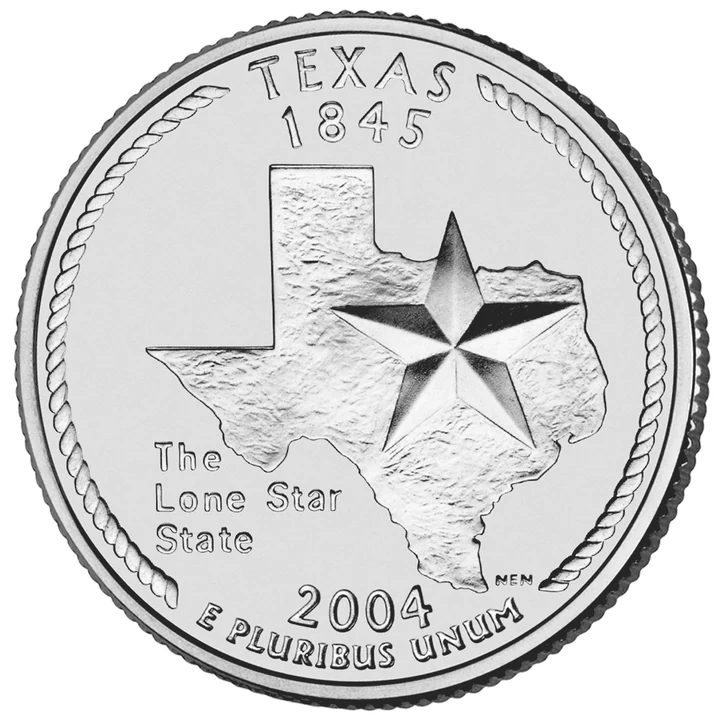
A Lone Star sits over Texas's outline while a rope lariat closes the composition around state identity, cattle history, cowboy imagery, and frontier spirit.
Exact Texas reverse from the U.S. Mint; shared program obverse.
28 / 50release order
4mint/finish issues
P · D · Smint marks
2004release year
Story in 30 Seconds
The reverse shows Texas's distinctive outline with a large five-pointed star superimposed on it, THE LONE STAR STATE inside the map, and a rope lariat encircling the central design.
The Mint says the lariat symbolizes Texas cattle and cowboy history and frontier spirit. The star and official nickname compress a much longer political symbol history into an instantly recognizable identity.
A 15-member state advisory committee authorized a statewide contest. Nearly 2,600 concepts became 17 Texas Numismatic Association finalists, then five committee choices; federal advisers reviewed them, Governor Rick Perry submitted the preferred design, and the Treasury Secretary approved it.
Collectors should distinguish P and D circulation strikes, S clad proof, and S 90% silver proof. Star points, map edges and texture, rope strands and loop, inscriptions, and NE initials are the main diagnostic zones.
Public Law 105-124 ordered state reverses by constitutional ratification or admission. Texas entered the Union on December 29, 1845 as the twenty-eighth state, so its quarter became the program's twenty-eighth coin and third 2004 release. One reverse could not represent Indigenous nations, Spanish and Mexican rule, the Republic, annexation, slavery and emancipation, borderlands, ranching, oil, agriculture, cities, migration, civil rights, spaceflight, or every community. The issued design chose three broad symbols rather than one event or place.
Texas's modern outline grew from a borderlands history involving Indigenous homelands, Spanish and Mexican governance, the Republic of Texas, annexation, war, treaties, and later boundary settlement. A single star served Texas flags before and after statehood and THE LONE STAR STATE became the official nickname. Cattle raising and long-distance drives became powerful public images of Texas, although ranching also depended on Tejano, Black, Indigenous, Mexican, and Anglo workers, changing land tenure, railroads, markets, and environmental conditions. The coin presents unity and frontier confidence while omitting those conflicts and communities.
The large five-pointed star is the visual center. Official Texas history traces Lone Star use through the Republic era, and the nickname now formally identifies the state. The coin does not reproduce the Texas flag; it isolates the star as a compact emblem.
The state outline supplies instant geographic recognition. A stippled interior separates land from the smoother field, while the star covers the north-central map. The outline is symbolic cartography, not a survey boundary or county map.
A rope lariat forms an almost complete circle. The Mint explicitly connects it to cattle, cowboys, and frontier spirit. It is a looped working rope, not a decorative border, whip, snake, state seal, or proof of one named ranch, trail, rider, or cattle drive.
World Coin Book reads the lariat's enclosure as visual unity: map, star, and nickname are gathered into one bounded Texas identity. That is editorial interpretation; the Mint's documented explanation is specifically cattle, cowboy history, and frontier spirit.
The design's clarity depends on omission. It leaves out people, cities, landscapes, industries beyond cattle, Indigenous and Tejano histories, slavery, emancipation, border conflict, oil, agriculture, music, and spaceflight. Its broad symbols communicate recognizability more than historical completeness.
Texas Senate Bill 100 authorized the governor to create a 15-member Texas Quarter Dollar Coin Design Advisory Committee. At its first public hearing on September 12, 2000, members debated an entirely open process versus selected artists, discussed a public theme vote, and created subcommittees for criteria, outreach, and schedule.
The eventual statewide contest drew nearly 2,600 candidate concepts. The Texas Numismatic Association selected 17 finalists; the advisory committee reduced those to the five designs it considered most emblematic. This was substantial public participation through submissions, but reviewed records do not document a binding statewide popular vote on the final five.
Federal review did not produce one unanimous preference. The CFA accepted the state's preferred design but favored candidate No. 2, a dominant large star, asking that its tiny state outline be removed. The CCAC favored a simple state outline, star, and THE LONE STAR STATE; its report says the Treasury Secretary approved that candidate and four similarly themed designs.
Texas then submitted its preferred candidate from the five: one border outline, a textured interior, THE LONE STAR STATE, and an encircling lariat. Governor Rick Perry submitted the preference and the Secretary of the Treasury approved it. The reviewed record does not identify a separate public vote total or establish that advisory preferences were binding.
The original concept came from Arlington resident Daniel Miller; the Mint credits Norman E. Nemeth as reverse designer and sculptor of the issued coin. The surviving official sources do not preserve a complete Miller-to-Mint change log, every candidate image, or every artist assignment.
Procedures varied by state and changed during the program; each researched state page must document its actual path.
Alternative Designs
Five similarly themed candidates reached federal review, but reviewed primary records do not preserve public titles and complete art for all five. CFA documents candidate No. 2 as a large central star with a small state outline it wanted removed; CCAC documents a simple state-outline-and-star candidate with THE LONE STAR STATE and says four additional similarly themed candidates were also approved. The issued state preference added a textured map and encircling lariat. World Coin Book does not invent missing layouts, rankings, or candidate symbolism.
Five-pointed emblem of Texas identity and its official nickname.
Texas outline
Modern state silhouette used as the design's geographic identifier.
Lariat
Looped rope symbolizing cattle, cowboy history, and frontier spirit.
Daniel Miller
Arlington resident credited with the original selected concept.
Norman E. Nemeth
U.S. Mint artist who designed and sculpted the issued reverse.
Rick Perry
Governor who submitted Texas's preferred candidate for final approval.
Focused Timeline
Republic-era Lone Star
Statehood
Cattle-drive era
Program authorization
State authorization
First hearing
Statewide contest
Federal advisory review
Final approval
Release
Launch
Official Explanation and Interpretation
Artists and relief
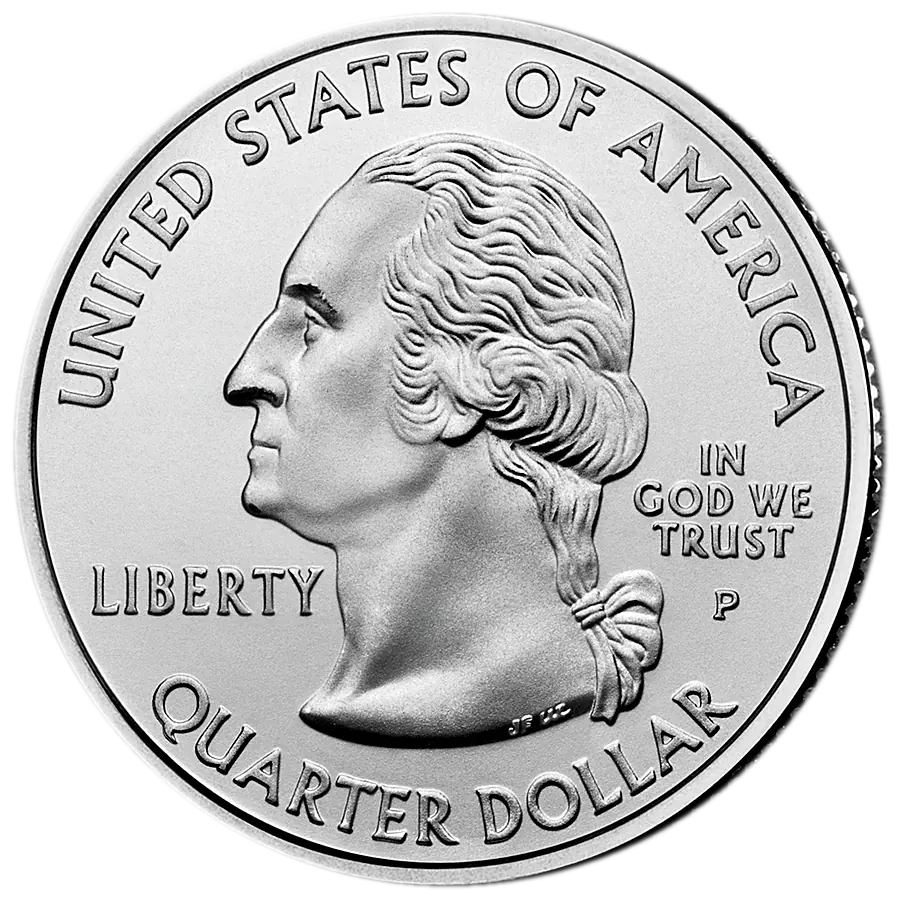
John Flanagan's Washington portrait, adapted and sculpted for the program by William Cousins, appears on the shared obverse. Arlington resident Daniel Miller originated the selected Texas concept. The Mint credits U.S. Mint sculptor-engraver Norman E. Nemeth as reverse designer and sculptor; his NE initials appear near the lariat. Nemeth translated map, star, typography, stippled land, and rope strands into shallow production relief. Reviewed records do not preserve every change from Miller's submission through five Mint candidates to Nemeth's final model.
P and D are circulation issues. Both S issues were sold in proof products; the silver proof is a distinct 90% silver composition. Mintages are established catalog figures retained with an explicit source-audit limit.
Identification Guide
Identify the reverse by a large star over Texas's stippled outline, THE LONE STAR STATE, and an encircling rope lariat. P, D, or S appears on the obverse beside Washington's hair ribbon. P and D are circulation strikes; S issues are proofs. The clad proof normally shows a copper-colored core at the reeded edge and weighs 5.67 g; the 90% silver proof lacks that stripe and weighs about 6.25 g.
Condition Guide
Inspect star points and center, panhandle and coastline edges, map texture, lariat loop and twisted strands, THE LONE STAR STATE, dates, motto, and NE. First wear dulls the broad star and exposed map and rope relief and breaks luster. Soft rope strands, map stippling, letters, or star points may remain lustrous from weak strike or die state rather than wear.
Open fields around the star and outside the rope show contact marks, scrapes, residue, and cleaning. Check proofs for hairlines, haze, spots, fingerprints, frost breaks, and reduced cameo. Compare normal examples before calling an extra rope strand, doubled star point, missing map texture, filled letter, or altered NE a mint error.
Mint Errors vs. Damage
Recognized catalog varieties: none are listed in current World Coin Book Texas issue records. This evidence boundary does not prove no minor die varieties exist.
Genuine mint errors can include off-center strikes, broadstrikes, clips, wrong planchets, struck-through material, retained cuds, or substantial die cracks. Attribution requires correct metal flow, weight, geometry, and repeatable evidence.
An extra rope strand, doubled star point, extra map border, missing stippling, doubled THE LONE STAR STATE, or altered NE is not rare by appearance alone. Mechanical doubling, die deterioration, grease, weak strike, glare, image compression, wear, and impacts readily change shallow details.
Scratches mistaken for rope fibers, dents mistaken for map features, flattened rims, dryer damage, corrosion, glue, plating, polishing, and heat color are post-mint damage. The lariat is not a snake or whip, the star does not mark Austin or one battle site, the outline is not the Republic's maximum claimed territory, and THE LONE STAR STATE is a nickname—not the constitutional state motto, which is Friendship.
Why Collectors Care
Durable value tiers
Worn P and D examples usually occupy the face-value design-set tier. Better circulation coins attract interest through full luster, clean fields, sharp star points, complete map outline and texture, separated rope strands, clear inscriptions, and visible NE. Clad proofs form a collector-product tier; silver proofs add 90% silver as a separate composition tier. Texas identity and the statewide contest add interest, not automatic rarity. World Coin Book gives no live price promise: compare dated references for exact mint, finish, grade, strike, and surfaces.
Official law and U.S. Mint records establish program facts and image identity. World Coin Book separates official explanation, historical analysis, and editorial interpretation.
Official descriptions, historical context, and World Coin Book interpretation are labeled separately. No live prices are asserted. Last verified:
Reviewed records identify the 15-member committee and first hearing but do not preserve every later meeting, minutes, subcommittee report, scoring rule, conflict control, or final report online.
The nearly 2,600 submissions, official form and rules, entrant demographics, preservation location, complete Texas Numismatic Association screening record, 17 finalists, scores, and rejection reasons were not located in a primary online archive.
Primary federal records describe five similarly themed candidates but do not preserve public titles, complete images, every artist assignment, full advisory discussion, or the state's ranking of all five.
No reviewed record documents a binding public vote among the five, its ballot, dates, eligibility, controls, totals, or legal effect; public participation is firmly documented through the statewide submission contest.
The complete Mint feasibility, model, state-feedback, governor-recommendation, Treasury-approval, inscription, die, and production-change trail remains incomplete.
Reviewed official records do not establish every change from Daniel Miller's concept to Norman E. Nemeth's issued relief or whether Miller reviewed the final model.
No official source assigns a location to the star, a specific rope or cattle trail to the lariat, a precise cartographic projection to the outline, or separate meaning to every stipple, rope strand, knot, star edge, and border gap.
Normalized mintages remain established catalog figures; future work should attach direct Mint annual-production and proof-sales evidence.