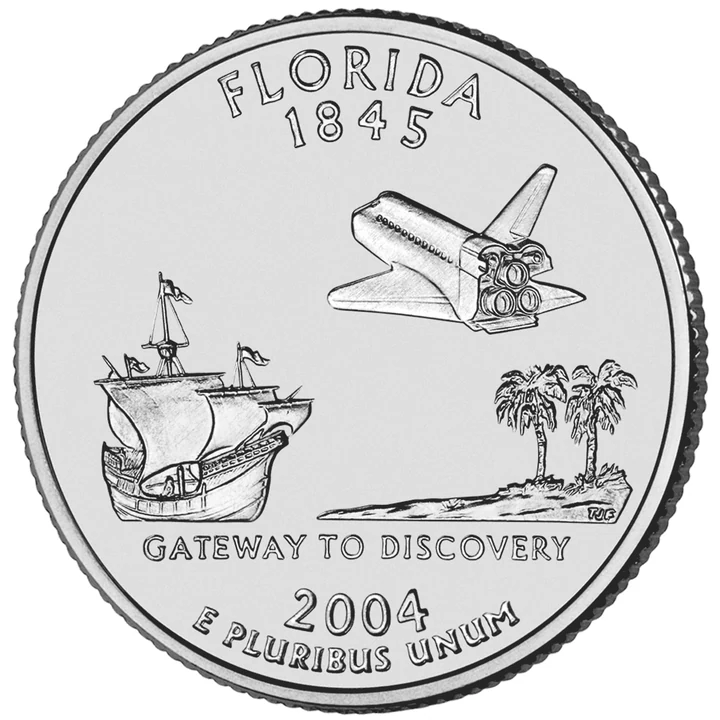
A Spanish galleon and Space Shuttle cross one Florida horizon, while sabal palms and GATEWAY TO DISCOVERY connect maritime encounter, state identity, and spaceflight.
Exact Florida reverse from the U.S. Mint; shared program obverse.
27 / 50release order
4mint/finish issues
P · D · Smint marks
2004release year
Story in 30 Seconds
The reverse shows a 16th-century Spanish galleon at left, a low strip of land with sabal palms, and a Space Shuttle rising at right. GATEWAY TO DISCOVERY is an actual inscription.
The Mint frames the ship and shuttle as Florida's long association with exploration—from early Spanish voyages to launches from Kennedy Space Center. The state tree roots that past-to-future arc in Florida's landscape.
A nine-person state committee reportedly reviewed about 1,500 concepts and sent ten to Governor Jeb Bush, who chose five. After Mint and federal advisory review, a three-week Internet and mail poll made Ralph Butler's Gateway to Discovery the public choice.
Collectors should distinguish P and D circulation strikes, S clad proof, and S 90% silver proof. Shuttle edges, rigging and sails, palm crowns, shoreline, inscriptions, and TF initials are the key diagnostic zones.
Public Law 105-124 ordered state reverses by constitutional ratification or admission. Florida entered the Union on March 3, 1845 as the twenty-seventh state, so its quarter became the program's twenty-seventh coin and second 2004 release. One reverse could not represent Indigenous nations, Spanish and British rule, slavery and emancipation, migration, agriculture, tourism, cities, the Everglades, hurricanes, civil rights, beaches, or every community. The selected design instead organizes Florida around movement and discovery across sea, land, and sky.
Florida is a peninsula between the Atlantic Ocean and Gulf of Mexico whose coastlines connected Indigenous communities and later European and Atlantic worlds. Spain established St. Augustine in 1565; centuries later, launch facilities at Cape Canaveral and Kennedy Space Center made Florida a departure point for human and robotic space missions. The sabal palm is the official state tree. The coin compresses these unlike histories into one forward-moving exploration story, while leaving conquest, colonial violence, forced labor, displacement, environmental change, and the many people behind ships and spacecraft outside the frame.
The galleon enters from the left under full sails. Official descriptions call it a 16th-century Spanish galleon and use it to mark Florida's early European exploration. It should not be read as a portrait of a named vessel, a peaceful first contact, or the beginning of Florida history; Indigenous histories long predate Spanish arrival.
A thin landform and sabal palms hold the center. The palms identify Florida through its official state tree, but the reviewed sources do not name a literal island, coast, or number of trees. Their low horizontal placement gives the ship and shuttle a shared Florida horizon.
The Space Shuttle climbs at right. Kennedy Space Center made Florida a launch point for major space missions, yet the generic orbiter is not officially identified as Discovery, Atlantis, Challenger, Columbia, or Endeavour. The program ended in 2011, so the image now records a completed era as well as the future-facing identity chosen in 2003.
GATEWAY TO DISCOVERY supplies the argument linking ship and spacecraft. Butler later said he added the phrase for Florida's long exploration history. World Coin Book reads the left-to-right, sea-to-sky movement as a compressed past-to-future sequence; that compositional reading is editorial, not a separate Mint formula.
The design celebrates curiosity, launch, and arrival while simplifying their consequences. It omits Indigenous agency, conquest, slavery, immigration, tourism, agriculture, urban Florida, the Everglades, environmental risk, and the workers who navigated, built, launched, and supported the represented technologies.
The surviving secondary reconstruction says Governor Jeb Bush appointed a nine-person Florida Commemorative Quarter Committee. The committee reviewed about 1,500 submitted concepts and recommended ten; Bush selected five for development and public consideration.
The five documented themes were Gateway to Discovery; St. Augustine, centered on Castillo de San Marcos; The Everglades, with a heron and sawgrass; America's Spaceport, with shuttle and state outline; and Fishing Capital of the World, with sailfish. Federal CFA minutes confirm five candidates and record that the CFA and the contemporary coin advisory committee preferred Everglades first and St. Augustine second.
The CFA suggested inscription placement for Everglades and removal of a dolphin from St. Augustine. It found the other three designs unacceptable; revised versions used fewer elements but remained disfavored. These minutes show advisory review, not the final decision.
Florida then ran a three-week Internet and mail poll. Contemporary and later accounts report about 424,000 ballots, with Gateway to Discovery winning 123,515; a Florida Senate retrospective identifies the quarter process as statewide public input. Bush followed that result and forwarded the selected concept through the federal process.
The Mint now credits Ralph Butler as reverse designer and T. James Ferrell as reverse sculptor. Reviewed records do not preserve the committee's full file, all submissions, exact vote controls, every model revision, the governor's formal recommendation, Treasury approval instrument, or a complete Butler-to-Ferrell change log.
Procedures varied by state and changed during the program; each researched state page must document its actual path.
Alternative Designs
Four losing finalists are documented. The Everglades showed a great white heron amid sawgrass; St. Augustine centered Castillo de San Marcos and initially included a dolphin; America's Spaceport paired a shuttle with Florida's outline; Fishing Capital of the World used a sailfish. CFA preferred Everglades and then St. Augustine, while the public chose Gateway to Discovery. Reviewed primary records do not reproduce every final model or establish complete artist and revision histories, so World Coin Book does not invent their exact layouts.
Use the complete text cards below as the keyboard and screen-reader equivalent of the image.
16th-century Spanish galleon
Official explanation: The Mint identifies a 16th-century Spanish galleon and links it to Florida's early European exploration.
Historical context: Spanish voyages and the 1565 settlement at St. Augustine belong to a colonial history that followed long Indigenous histories and included conflict and displacement.
World Coin Book interpretation: The left-facing historical technology begins a visual journey that the shuttle continues upward at right.
Official explanation: The inscriptions give state, admission year, issue year, national motto, and T. James Ferrell's initials.
Historical context: The Mint credits Ralph Butler for reverse design and Ferrell for sculpting the issued relief.
World Coin Book interpretation: Rim text fixes chronology while TF records the sculptor; Butler's role survives in the official credit rather than separate initials.
Generic 16th-century vessel representing Florida's early European exploration.
Sabal palm
Florida's official state tree and the reverse's central landscape marker.
Kennedy Space Center
Florida launch center behind the Space Shuttle symbol.
Ralph Butler
Florida illustrator who created the winning concept and phrase Gateway to Discovery.
T. James Ferrell
U.S. Mint medallic artist who sculpted the issued reverse.
Jeb Bush
Governor who selected five candidates and accepted the public choice.
Focused Timeline
Indigenous nations sustain long histories across the Florida peninsula
Spain establishes St. Augustine
Florida enters the Union as the twenty-seventh state
Launch Operations Center is established on Merritt Island; it is later named Kennedy Space Center
Public Law 105-124 authorizes the program
State committee and governor reduce public concepts to five candidates
Federal advisory bodies review the five designs
Gateway to Discovery wins the public poll
Mint releases Florida quarter to the Federal Reserve
Official launch at Kennedy Space Center
Space Shuttle Program ends, changing the image from future promise to historical record
Official Explanation and Interpretation
Artists and relief
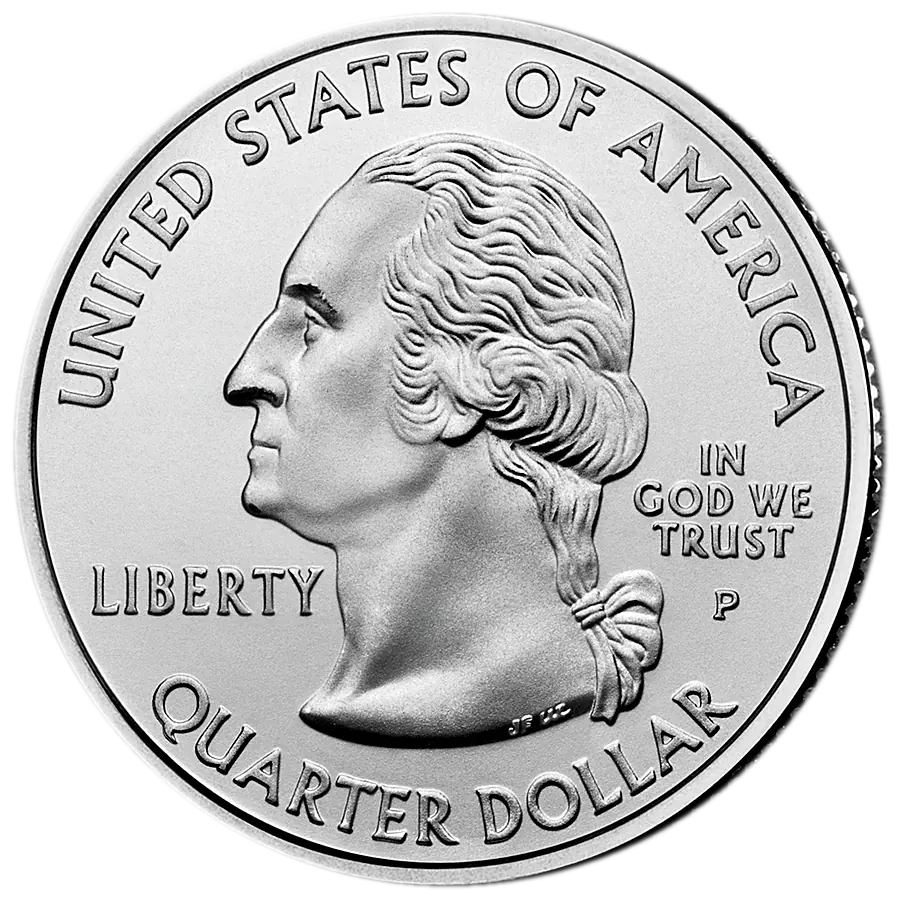
John Flanagan's Washington portrait, adapted and sculpted for the program by William Cousins, appears on the shared obverse. Florida illustrator Ralph Butler created the winning citizen design and the phrase GATEWAY TO DISCOVERY. The Mint credits Butler as reverse designer and U.S. Mint medallic artist T. James Ferrell as reverse sculptor. Ferrell translated the selected drawing into shallow coin relief, balancing rigging, sails, palms, shuttle, inscriptions, and production limits. CFA minutes document requested simplification, but reviewed records do not preserve every candidate model, exact Butler-to-Ferrell revision, die change, or Butler review of the final relief.
P and D are circulation issues. Both S issues were sold in proof products; the silver proof is a distinct 90% silver composition. Mintages are established catalog figures retained with an explicit source-audit limit.
Identification Guide
Identify the reverse by a Spanish galleon at left, sabal palms on a central shore, a rising Space Shuttle at right, and GATEWAY TO DISCOVERY. P, D, or S appears on the obverse beside Washington's hair ribbon. P and D are circulation strikes; S issues are proofs. The clad proof normally shows a copper-colored core at the reeded edge and weighs 5.67 g; the 90% silver proof lacks that stripe and weighs about 6.25 g.
Condition Guide
Inspect shuttle nose, wing and tail edges; galleon sails, masts and rigging; palm crowns and trunks; shoreline; GATEWAY TO DISCOVERY; dates, motto, and TF. First wear dulls exposed shuttle and sail relief and breaks luster. Fine rigging, palm fronds, letters, or shuttle edges may be weak yet lustrous from strike or die state rather than wear.
Open fields around the shuttle and ship reveal contact marks, scrapes, residue, and cleaning; dense rigging and palms can hide impacts. Check proofs for hairlines, haze, spots, fingerprints, frost breaks, and reduced cameo. Compare normal examples before calling a missing rope, frond, window, exhaust line, letter, or TF a filled die or struck-through error.
Mint Errors vs. Damage
Recognized catalog varieties: none are listed in current World Coin Book Florida issue records. This evidence boundary does not prove no minor die varieties exist.
Genuine mint errors can include off-center strikes, broadstrikes, clips, wrong planchets, struck-through material, retained cuds, or substantial die cracks. Attribution requires correct metal flow, weight, geometry, and repeatable evidence.
An extra sail, mast, rope, palm frond, shuttle window, exhaust line, doubled GATEWAY TO DISCOVERY, or altered TF is not rare by appearance alone. Mechanical doubling, die deterioration, grease, weak strike, glare, image compression, wear, and impacts readily change shallow details.
Scratches mistaken for rigging or exhaust, dents mistaken for windows, flattened rims, dryer damage, corrosion, glue, plating, polishing, and heat color are post-mint damage. The ship is not a documented named galleon, the orbiter is not officially identified as Space Shuttle Discovery, the palms are not a mapped grove, and GATEWAY TO DISCOVERY is an inscription—not proof that either vehicle discovered Florida.
Why Collectors Care
Durable value tiers
Worn P and D examples usually occupy the face-value design-set tier. Better circulation coins attract interest through full luster, clean open fields, crisp shuttle contours, complete galleon rigging and sails, separated palm fronds, a continuous shoreline, sharp inscriptions, and visible TF. Clad proofs form a collector-product tier; silver proofs add 90% silver as a separate composition tier. Public-choice and space-history appeal add interest, not automatic rarity. World Coin Book gives no live price promise: compare dated references for exact mint, finish, grade, strike, and surfaces.
Official law and U.S. Mint records establish program facts and image identity. World Coin Book separates official explanation, historical analysis, and editorial interpretation.
Official descriptions, historical context, and World Coin Book interpretation are labeled separately. No live prices are asserted. Last verified:
Reviewed official online records do not preserve the order creating the nine-person committee, its complete roster, appointments, meetings, minutes, scoring, conflict controls, or final report.
The approximately 1,500 submissions, eligibility rules, submitter demographics, preservation location, committee reduction method, ten recommendations, and governor's reasons for choosing five were not located in a primary archive.
The public poll is well reported, but reviewed official records do not preserve its exact dates, ballot wording, residency rules, duplicate controls, mail and Internet subtotals, full candidate totals, certification, or legal effect.
CFA minutes document five themes, preferences, and revisions but do not reproduce every candidate drawing or model, identify every artist, or preserve all advisory comments.
The complete Mint feasibility, model, state-feedback, governor-recommendation, Treasury-approval, inscription, die, and production-change trail remains incomplete.
Reviewed records do not establish every element removed, retained, resized, or added between Butler's drawing and Ferrell's issued relief, or whether Butler approved the final model.
No official source names a specific galleon, orbiter, coastline, island, palm grove, number of trees, launch, mission, voyage, or separate symbolic meaning for each sail, rope, frond, window, and exhaust line.
Normalized mintages remain established catalog figures; future work should attach direct Mint annual-production and proof-sales evidence.