708–958
Kōchō Jūnisen: The Twelve Ancient Court Coin Types
Kōchō Jūnisen is the conventional collective name for twelve official court coin types beginning with Wadō Kaichin in 708 and ending with Kengen Taihō in 958. The group is a chronological and historical framework, not evidence that every issue circulated equally, retained the same quality, or enjoyed the same public acceptance.
皇朝十二銭Kōchō Jūnisen
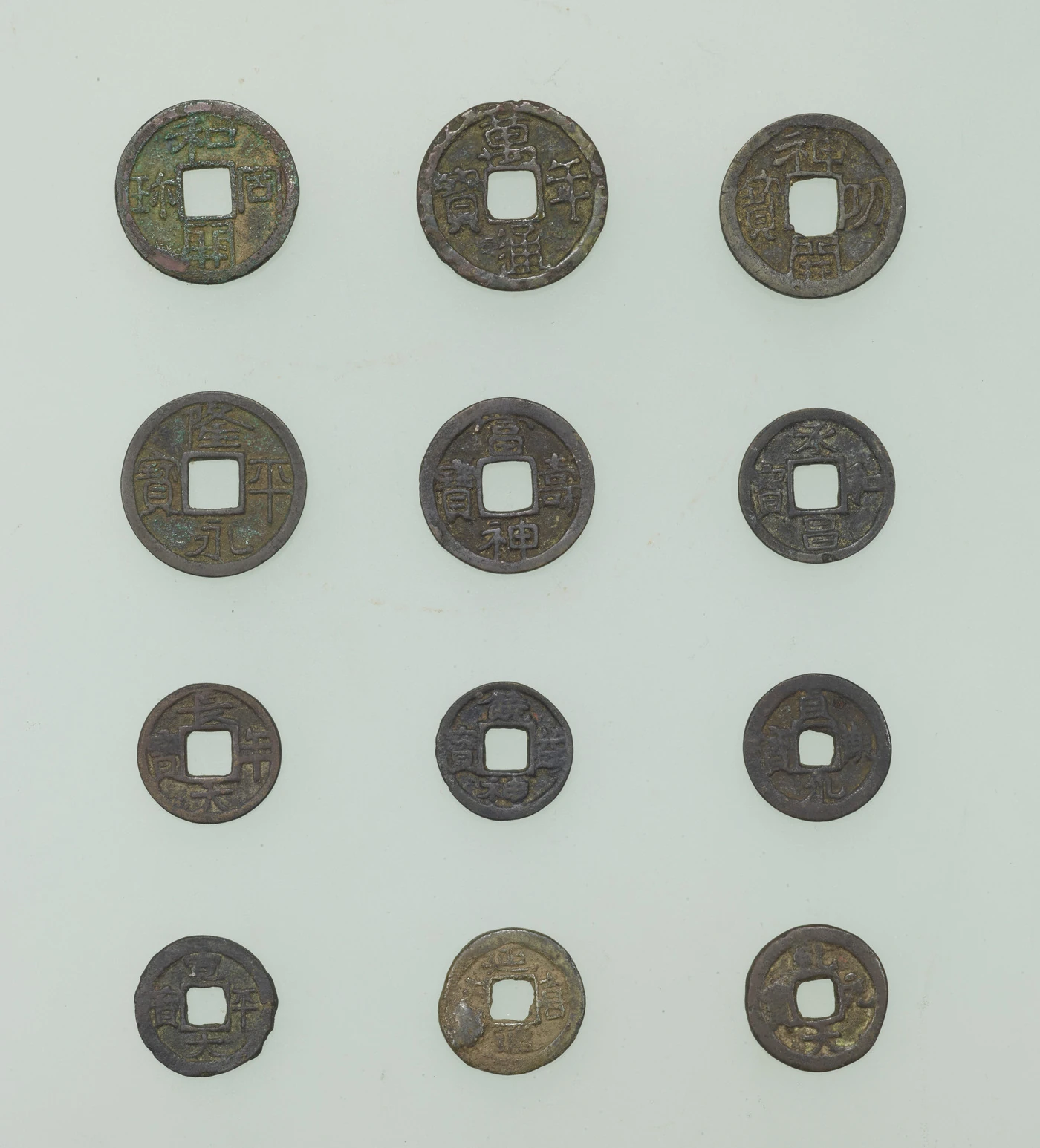
- Date span
- 708–958
- Issues
- 12
- First
- Wadō Kaichin
- Final
- Kengen Taihō
Sequence explorer
Twelve official court coin types
Literally 'the twelve coins of the imperial court.' Modern museum treatment groups Wado Kaichin with the eleven later court issues while separately recognizing earlier Fuhonsen.
-
01
和同開珎
Wadō Kaichin
708 · 和銅 1
Empress Genmei
- Weight
- 3.4 g mean
- Diameter
- 24.46 mm mean
-
02
萬年通寶
Mannen Tsūhō
760 · 天平宝字 4
Emperor Junnin
- Weight
- 2.56–6.69 g
- Diameter
- 24.56–27.45 mm
-
03
神功開寶
Jingū Kaihō
765 · 天平神護 1
Empress Shōtoku
- Weight
- 2.5–5.6 g
- Diameter
- 24.5–27 mm
-
04
隆平永寶
Ryūhei Eihō
796 · 延暦 15
Emperor Kanmu
- Weight
- 2.35–5.89 g
- Diameter
- 24.03–27.88 mm
-
05
富壽神寶
Fujū Shinpō
818 · 弘仁 9
Emperor Saga
- Weight
- 2.13–4.59 g
- Diameter
- 22.53–25.21 mm
-
06
承和昌寶
Jōwa Shōhō
835 · 承和 2
Emperor Ninmyō
- Weight
- 2.01–3.33 g
- Diameter
- 20.47–23.36 mm
-
07
長年大寶
Chōnen Taihō
848 · 嘉祥 1
Emperor Ninmyō
- Weight
- 1.26–2.97 g
- Diameter
- 19.24–21.21 mm
-
08
饒益神寶
Nyōyaku Shinpō
859 · 貞観 1
Emperor Seiwa
- Weight
- 1.47–2.98 g
- Diameter
- 18.32–20.28 mm
-
09
貞観永寶
Jōgan Eihō
870 · 貞観 12
Emperor Seiwa
- Weight
- 1.74–3.4 g
- Diameter
- 18.86–20.14 mm
-
10
寛平大寶
Kanpyō Taihō
890 · 寛平 2
Emperor Uda
- Weight
- 1.16–3.32 g
- Diameter
- 18.04–20.25 mm
-
11
延喜通寶
Engi Tsūhō
907 · 延喜 7
Emperor Daigo
- Weight
- 1.85–3.64 g
- Diameter
- 18.47–20.36 mm
-
12
乾元大寶
Kengen Taihō
958 · 天徳 2
Emperor Murakami
- Weight
- 2.83 g (1 observed specimen)
- Diameter
- 19.96 mm (1 observed specimen)
Comparative register
Identity, measurements, and evidence
Observed ranges include casting and condition variation. A single observation is not displayed as a range.
| Seq. | Coin | Inscription | Year / era | Authority | Metal | Weight | Diameter | Major note | Confidence |
|---|---|---|---|---|---|---|---|---|---|
| 1 | Wadō Kaichin | 和同開珎 | 708和銅 1 | Imperial court under Empress Genmei | copper alloy, silver issue | 3.4 g mean | 24.46 mm mean | Issued in 708 as a state coin modeled within the Tang Kaiyuan Tongbao monetary and visual tradition. The court promoted use through rank incentives and payments connected with state construction. | high for identity, issue date, inscription, and sequence; variable at specimen and subtype level |
| 2 | Mannen Tsūhō | 萬年通寶 | 760天平宝字 4 | Imperial court under Emperor Junnin | copper alloy | 2.56–6.69 g | 24.56–27.45 mm | Issued with the gold Kaiki Shōhō and silver Taihei Genpō. It was declared equal to ten Wado Kaichin, a policy that did not secure durable acceptance and encouraged private casting. | high for identity, sequence, issue date, and authority; medium for generalized specifications |
| 3 | Jingū Kaihō | 神功開寶 | 765天平神護 1 | Imperial court under Empress Shōtoku | copper alloy | 2.5–5.6 g | 24.5–27 mm | The third issue in the official twelve-coin sequence, released during Empress Shōtoku's reign after the 760 replacement coinage. | high for identity, issue date, authority, and sequence; medium for generalized measurements |
| 4 | Ryūhei Eihō | 隆平永寶 | 796延暦 15 | Imperial court under Emperor Kanmu | copper alloy | 2.35–5.89 g | 24.03–27.88 mm | Declared at ten old coins per new coin. Older coin use was initially restricted, then permitted again in 808 when the supply of new coin was insufficient. | high for identity, issue date, authority, and policy context |
| 5 | Fujū Shinpō | 富壽神寶 | 818弘仁 9 | Imperial court under Emperor Saga | copper alloy | 2.13–4.59 g | 22.53–25.21 mm | Official records addressed production targets and accepted poorly formed or partly illegible pieces, illustrating supply pressure and declining production quality. | high for identity, issue date, authority, and historical quality evidence |
| 6 | Jōwa Shōhō | 承和昌寶 | 835承和 2 | Imperial court under Emperor Ninmyō | copper alloy | 2.01–3.33 g | 20.47–23.36 mm | Issued in Jōwa 2 and identified by the Currency Museum as the first Japanese coin whose inscription used the era name. | high for identity, issue date, authority, and era-name significance |
| 7 | Chōnen Taihō | 長年大寶 | 848嘉祥 1 | Imperial court under Emperor Ninmyō | copper alloy | 1.26–2.97 g | 19.24–21.21 mm | Issued after the appearance of a white turtle and the era change to Kashō; the name expresses longevity. | high for identity, issue date, authority, and documentary context |
| 8 | Nyōyaku Shinpō | 饒益神寶 | 859貞観 1 | Imperial court under Emperor Seiwa | copper alloy | 1.47–2.98 g | 18.32–20.28 mm | Its name expresses abundant benefit or wealth. Currency Museum commentary treats it as particularly scarce among the Heian issues, but this catalog does not convert that observation into a census. | high for identity, issue date, and authority; medium for comparative rarity wording |
| 9 | Jōgan Eihō | 貞観永寶 | 870貞観 12 | Imperial court under Emperor Seiwa | copper alloy | 1.74–3.4 g | 18.86–20.14 mm | The court opened a new office, recalled old coins, and in 872 criticized poor lettering and weak rims after market rejection. This is direct evidence that quality and trust were linked. | high for identity, issue date, authority, and documented quality complaint |
| 10 | Kanpyō Taihō | 寛平大寶 | 890寛平 2 | Imperial court under Emperor Uda | copper alloy | 1.16–3.32 g | 18.04–20.25 mm | By this issue, new coinage was no longer closely tied to major capital-construction payments in the way early state coin use had been. | high for identity, issue date, authority, and sequence |
| 11 | Engi Tsūhō | 延喜通寶 | 907延喜 7 | Imperial court under Emperor Daigo | copper alloy | 1.85–3.64 g | 18.47–20.36 mm | The Engi-shiki permitted use of a coin if one character remained clear, evidence of how far legibility and manufacturing quality had declined. | high for identity, issue date, authority, and documentary quality rule |
| 12 | Kengen Taihō | 乾元大寶 | 958天徳 2 | Imperial court under Emperor Murakami | copper alloy | 2.83 g (1 observed specimen) | 19.96 mm (1 observed specimen) | Issued in 958, Kengen Taiho was the final new issue in the official ancient court sequence. Domestic coin issuance then ceased for centuries while commodity money and, later, imported Chinese cash filled monetary roles. | high for identity, issue date, authority, and final-sequence position; low for generalized measurements because only one catalog specimen was measurable |
Measured trend
Observed diameter and weight shift
Bar length uses each issue's range midpoint or catalog mean. It visualizes the source data; it does not fill gaps or define official standards.
Repeated monetary interventions
New issues repeatedly attempted to restore supply, revenue, and the court's preferred unit of account. Declaring a new coin equal to ten old coins could create nominal value without guaranteeing acceptance.
Metal, size, and manufacture
Museum measurements show a broad shift from larger early pieces toward smaller later ones. Chemical samples show changing copper, tin, lead, iron, arsenic, and antimony patterns. These are trends across measured specimens, not one fixed formula for each name.
Quality and trust
Copper scarcity, more lead, weak rims, poor lettering, private casting, high official exchange ratios, and inadequate supply interacted. The decline was institutional and material, not a single-cause story.
After 958
After Kengen Taiho, the court issued no new coin type for centuries. Rice, silk, and cloth served monetary roles before large imports of Chinese cash later reshaped circulation.
Evidence
Sources and scope
These links support the claims on this page. Source authority does not imply permission to republish source images.
Fuhonsen and Mumon Ginsen context, the 708 issue of Wado Kaichin, state monetary policy, quality decline, the 958 final issue, and the return to commodity money.
Open sourceOfficial museum grouping, specimen catalog, readings, and specimen-level measurements for the twelve court coin types.
Open sourceThe canonical order and issue years of the twelve ancient court coin types.
Open sourceMumon Ginsen, Fuhonsen, Wado Kaichin, Mannen Tsuho, Jingu Kaiho, documentary issue dates, circulation policy, and reading evidence.
Open sourceIssue dates, emperors, policy evidence, production decline, and historical notes for Ryuhei Eiho through Kengen Taiho.
Open sourceMeasured copper, tin, lead, iron, arsenic, and antimony patterns across sampled ancient coins, with specimen-level limitations.
Open source