Royal portrait silver replaced the two-worlds design in 1772, carried Mexico City’s paired assayers into a new fineness standard, and remained in production through war and independence-era disruption.
◆
Ferdinand VII coinage is both late Spanish-colonial money and independence-era evidence. Branch and provisional issues belong to separate taxonomy records unless a specific coin proves the relationship.
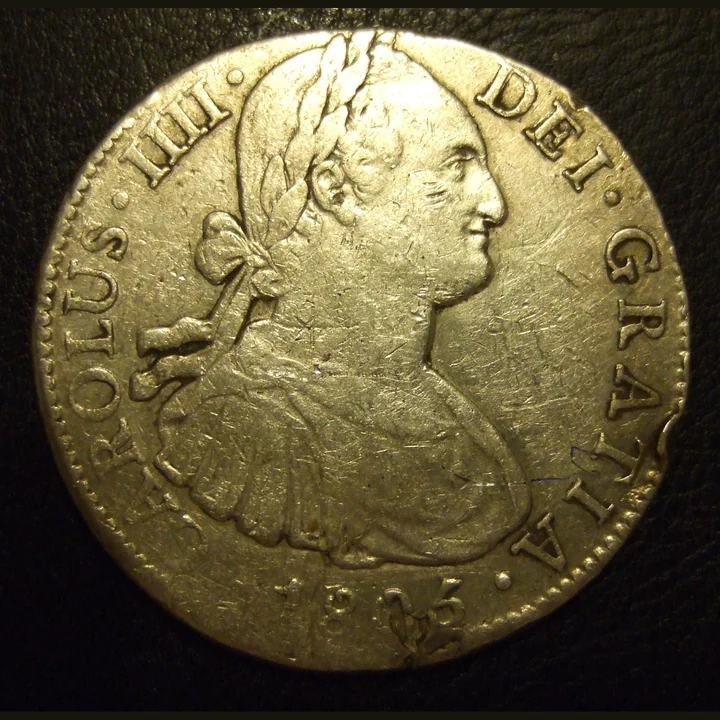
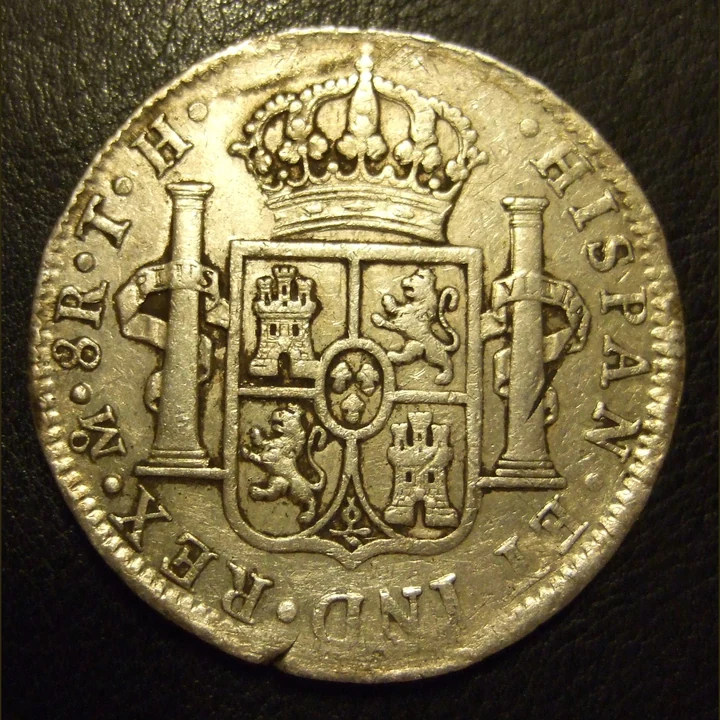
Representative Charles IV 1805 M° TH Portrait 8 Reales; not a universal die model for the series. Jerry “Woody” · CC BY-SA 2.0
◆1772–1821Series dates
◆3Authorities
◆3Type rows
◆5Sources
Series overview
Identity begins with evidence
Portrait, or busto, eight reales place the reigning monarch’s bust and titles opposite the crowned Spanish arms. Date, Mexico mark, denomination, and paired assayers remain essential, while changing portraits and wartime circumstances add another attribution layer.
Historical background
The new type appeared at Mexico City in 1772 after the final 1771 pillar issues. Charles III, Charles IV, and Ferdinand VII each have a canonical taxonomy series. The last reign overlaps the 1810–1821 independence struggle, so a date can belong simultaneously to a royal type sequence and an independence-period historical collection.
Portrait and legend must agree. Early Charles IV dates can retain a Charles III-style bust with an altered legend, and transition marks can outlive an officer’s nominal appointment boundary. Read the full combination instead of matching one face or one pair of letters.
Obverse analysis
On the portrait side, compare bust style, hair or laurel, drapery, truncation, monarch name, ordinal, titles, date, and punctuation. Wear concentrates on facial and hair high points; an unfamiliar portrait can be transitional rather than counterfeit, but must match the legend and date.
Reverse analysis
The crowned arms side carries the M° mintmark, paired assayer initials, and denomination 8 around the shield. Crown, shield quarters, eagle or central elements, rim, and letter punches provide both grading and authenticity evidence.
Edge and production method
Milled manufacture generally gives a round planchet and repeated edge pattern, but adjustment marks, weak centers, striking cracks, and later trade contact still occur. Counterstamps are post-strike interventions with their own authority and history, not original portrait varieties.
Method
Milled screw-press coinage
Edge
Patterned security edge; type and tooling must match issue
Fineness
Approximately .903 fine under the portrait standard
Series and monarch timeline
1772–1789
Charles III portrait series; first years include layout transitions from the pillar system.
1789–1808
Charles IV series; some early pieces retain the predecessor’s portrait with changed royal legend.
1808–1810
Ferdinand VII coinage begins during dynastic and imperial crisis.
1810–1821
Royal Mexico City portrait production continues while independence, branch-mint, provisional, and countermark systems coexist.
Mint and assayer structure
M, Mo, G, and Ch are resolved only with period, date, denomination, authority, assayer, and source context; no global alias expansion is permitted.
FM
Francisco Antonio de la Peña y Flores and Manuel de la Iglesia
1770–1777 · Pillar 1770–1771; Portrait from 1772
specialist-confirmed
FF
Francisco Antonio de la Peña y Flores and Francisco Arance y Cobos
1777–1783 · Portrait; transition marks overlap
specialist-confirmed
FM
Francisco Arance y Cobos and Mariano Rodríguez y Puerta
1783–1800 · Portrait; reused initials represent different people
specialist-confirmed
FT
Francisco Arance y Cobos and Tomás Butrón y Miranda
1800–1803 · Portrait; mark recorded from 1801
specialist-confirmed
TH
Tomás Butrón y Miranda and Henrique Buenaventura Asorín
1803–1809 · Portrait
specialist-confirmed
HJ
Henrique Buenaventura Asorín and José García Ansaldo
Series confirmed; dual colonial/independence context
Series row only
Major varieties and attribution dimensions
Charles IV legend with retained Charles III-style bust
Major portrait transition
Date and legend must agree with the attribution.
Assayer-pair transitions
Issue classifier
Reused FM does not name the same two officers in both periods.
Ferdinand VII portrait changes
Major design family
Preserve colonial and independence-period contexts.
Counterstamps
Post-strike authority evidence
Not an original portrait variety.
Key and scarce issues
Wartime dates, portrait transitions, assayer overlaps, mint context, surface quality, and counterstamp history can all affect availability. The page avoids a key-date list because no single scoped census was normalized for this build.
Series-specific grading
Assess portrait high points, hair or laurel, bust drapery, shield and crown, central devices, rim, and edge. Separate adjustment marks from scratches, weak strike from wear, and ordinary trade marks from cleaning, tooling, rim repair, or added counterstamps.
Authentication guide
Check mass, diameter, fineness response, portrait and legend compatibility, M° style, assayer/date pairing, edge, and die execution. Cast surfaces, transfer repetitions, altered dates, added marks, fabricated assayers, and mechanically applied false wear are warning signs. This guide is not a substitute for professional authentication.
Not a substitute for professional authentication.
Collecting guide
Begin with one coin for each monarch, then add a Charles IV transitional portrait and a Ferdinand VII independence-era date. Advanced sets track the officer pairs FM, FF, reused FM, FT, TH, HJ, and JJ with explicit date and identity notes.
Auction and market context
No price-guide values or “highest price” claims are published. Auction evidence is best used to document portrait transitions, pedigrees, counterstamps, and exceptional preservation after the coin’s identity, grade basis, currency, and premium treatment are normalized.
No Phase 1 realized-price record met the normalization requirements for identity, grade, certification context, currency, premium basis, and retrieved date. Auction sources are used only as contextual evidence until that package exists.