Historical collection
Spanish Colonial 8 Reales
Four distinct Mexico City traditions trace royal silver from rare early experimentation through hammered cobs, milled pillar dollars, and portrait coinage at the independence boundary.
Ferdinand VII portrait issues overlap the colonial and independence periods; the hierarchy preserves that dual context.
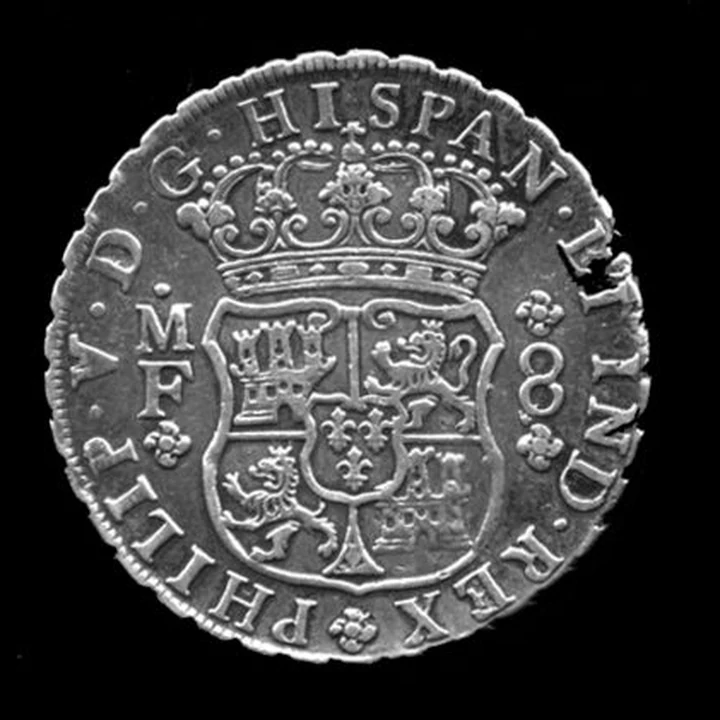
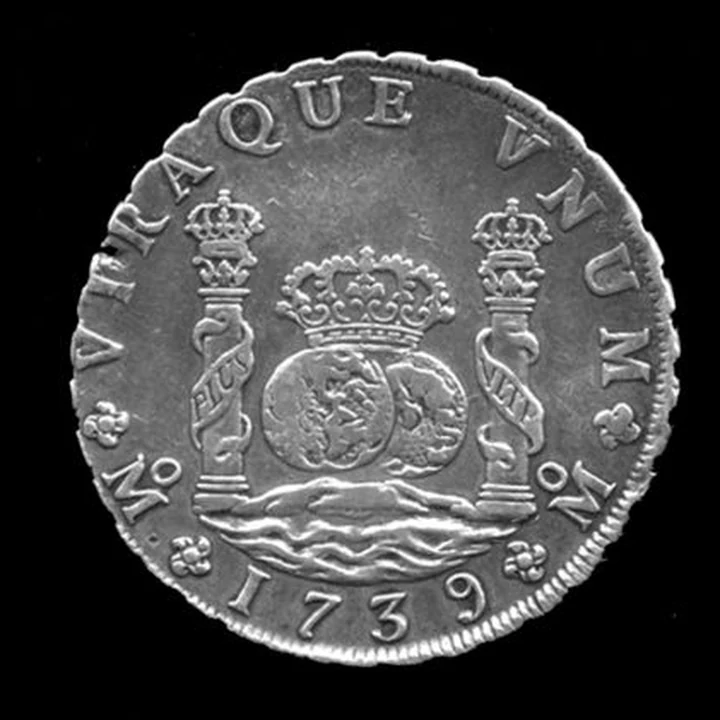
Spanish Crown and Mexico City
Royal authority remained the legal thread, but production was not static. Hammered coins can be irregular and incompletely struck because a prepared blank was placed between dies and struck by hand. The screw press introduced in the 1730s made rounder planchets, more complete designs, and a patterned edge.
Mint and assayer marks are evidence, not decoration. They identify a production institution and the officers responsible for metallic standard, but reused letter pairs can represent different people in different periods. Every attribution therefore combines monarch, date, design, mintmark, and assayer context.
Four production families cannot be flattened into one type
| Series | Dates | Production | Monarchs | Assayers | Edge | Weight | Difficulty |
|---|---|---|---|---|---|---|---|
| Charles and Joanna | 1538 evidence within 1536–1571 coinage | Hand-prepared planchet; hammer struck | Charles I · Joanna of Castile | R evidence; unresolved | Unfinished or irregular hammered edge | Eight-real standard requires specimen-level verification | Extreme; attribution and genuineness require specialist review |
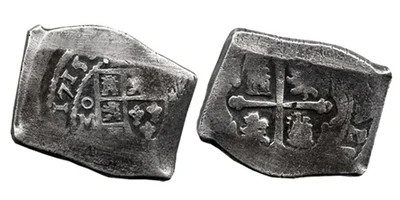
| Cob / Macuquina | 1572–1733 | Cut or prepared planchet; hammer struck | Philip II · Philip III · Philip IV · Charles II · Philip V | Issue-specific; incomplete corpus | Irregular hammered edge; no uniform security pattern | Eight-real standard; individual pieces vary through manufacture, clipping, and loss | Moderate to expert depending on visible marks and surface condition |
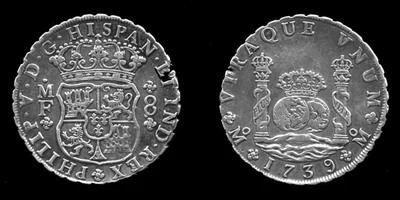
| Pillar / Columnario | 1732–1771 | Milled screw-press coinage on round planchets | Philip V · Ferdinand VI · Charles III | Paired initials, scoped identities | Patterned security edge; inspect by issue and tooling state | Eight-real milled standard, commonly cited near 27 g | Accessible by monarch; advanced by date, assayer, and die details |
| Portrait / Busto | 1772–1821 | Milled screw-press coinage | Charles III · Charles IV · Ferdinand VII | Paired initials, scoped identities | Patterned security edge; type and tooling must match issue | Eight-real milled standard, commonly cited near 27 g | Accessible by monarch; wartime and transition issues require advanced attribution |
Mature guides and research boundary
Charles and Joanna
Ocho reales de Carlos y JuanaA research page for the exceptional early Mexico City eight-real attribution, separated from the much broader and well-established Charles-and-Joanna lower-denomination coinage.
- Monarchs
- Charles I · Joanna of Castile
- Production
- Hand-prepared planchet; hammer struck
- Status
- Review required
 1572–1733
Cob / Macuquina
Ocho reales macuquinosMexico City’s cross-and-shield macuquinas turn incomplete strikes into an evidence problem: attribution combines visible date, mint, assayer, denomination, arms, cross, and planchet.
- Monarchs
- Philip II · Philip III · Philip IV · Charles II · Philip V
- Production
- Cut or prepared planchet; hammer struck
- Status
- Published
 1732–1771
Pillar / Columnario
Ocho reales columnariosThe columnario combined round milled production, a security edge, paired assayer initials, and the globes-and-pillars design that made Mexico City silver legible across global trade.
- Monarchs
- Philip V · Ferdinand VI · Charles III
- Production
- Milled screw-press coinage on round planchets
- Status
- Published
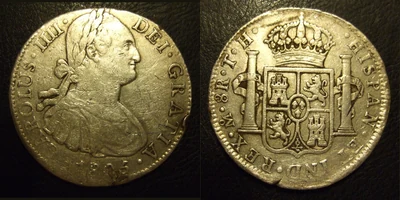 1772–1821
Portrait / Busto
Ocho reales de bustoRoyal portrait silver replaced the two-worlds design in 1772, carried Mexico City’s paired assayers into a new fineness standard, and remained in production through war and independence-era disruption.
- Monarchs
- Charles III · Charles IV · Ferdinand VII
- Production
- Milled screw-press coinage
- Status
- Published
Sources
- Las primeras monedas hechas en México: Carlos y Juana, 1536Casa de Moneda de México · tier 1 · 2026-07-21
Mint founding, two broad series, design and manual production.
- Antecedentes históricosCasa de Moneda de México · tier 1 · 2026-07-21
Official sequence from Charles-and-Joanna through cobs, pillar and portrait coinage.
- Moneda de Carlos y JuanaSecretaría de Cultura · tier 1 · 2026-07-21
Official object history; creates disclosed conflict on the start of 8-real production.
- Historia de la moneda y del billete en MéxicoBanco de México · tier 1 · 2026-07-21
Institutional monetary history and terminology.
- Charles and Joanna: Early SeriesMexican Numismatics · tier 2 · 2026-07-21
Rare assayer-R early 8-real evidence and 1538 context.
- Early Series: Eight RealesMexican Numismatics · tier 2 · 2026-07-21
Specialist discussion of the exceptional denomination and production difficulty.
- The Charles and Joanna Coinage of Mexico City, 1536–1571U.S. Mexican Numismatic Association · tier 2 · 2026-07-21
Specialist series structure and terminology.
- Cob assayers L and J, 1677–1723Mexican Numismatics · tier 2 · 2026-07-21
Late cob assayer evidence and transition complexity.
- Cob assayers, 1700–1746Mexican Numismatics · tier 2 · 2026-07-21
Late cob and early milled assayer context.
- Charles II cobs: BezerraMexican Numismatics · tier 2 · 2026-07-21
Specialist attribution example showing why cobs need issue-level evidence.
- Pillar coinageMexican Numismatics · tier 2 · 2026-07-21
Reform chronology, machinery, fineness, introduction and end dates.
- Pillar designMexican Numismatics · tier 2 · 2026-07-21
Design elements and Mexico mintmark.
- Pillar assayers, 1732–1771Mexican Numismatics · tier 2 · 2026-07-21
Pillar assayer identities, letter pairs and service spans.
- Assayer initialsMexican Numismatics · tier 2 · 2026-07-21
Meaning of paired chief-assayer initials.
- Bust coinageMexican Numismatics · tier 2 · 2026-07-21
1772 transition, design and Charles IV portrait transition.
- Bust coinage: assayersMexican Numismatics · tier 2 · 2026-07-21
Portrait assayer names, pairs, spans and transition notes.
- 1715 Mexico City 8 Reales cobWikimedia Commons · tier 3 · 2026-07-21
CC BY-SA 3.0 documentary photograph and stated 1715 Fleet provenance.
- Philip V 1739 Mexico 8 RealesWikimedia Commons · tier 3 · 2026-07-21
Public-domain documentary image and visible issue description.
- Charles IV 1805 Mexico 8 Reales portrait sideWikimedia Commons · tier 3 · 2026-07-21
CC BY-SA 2.0 documentary portrait photograph.
- Charles IV 1805 Mexico 8 Reales arms sideWikimedia Commons · tier 3 · 2026-07-21
CC BY-SA 2.0 documentary arms photograph.