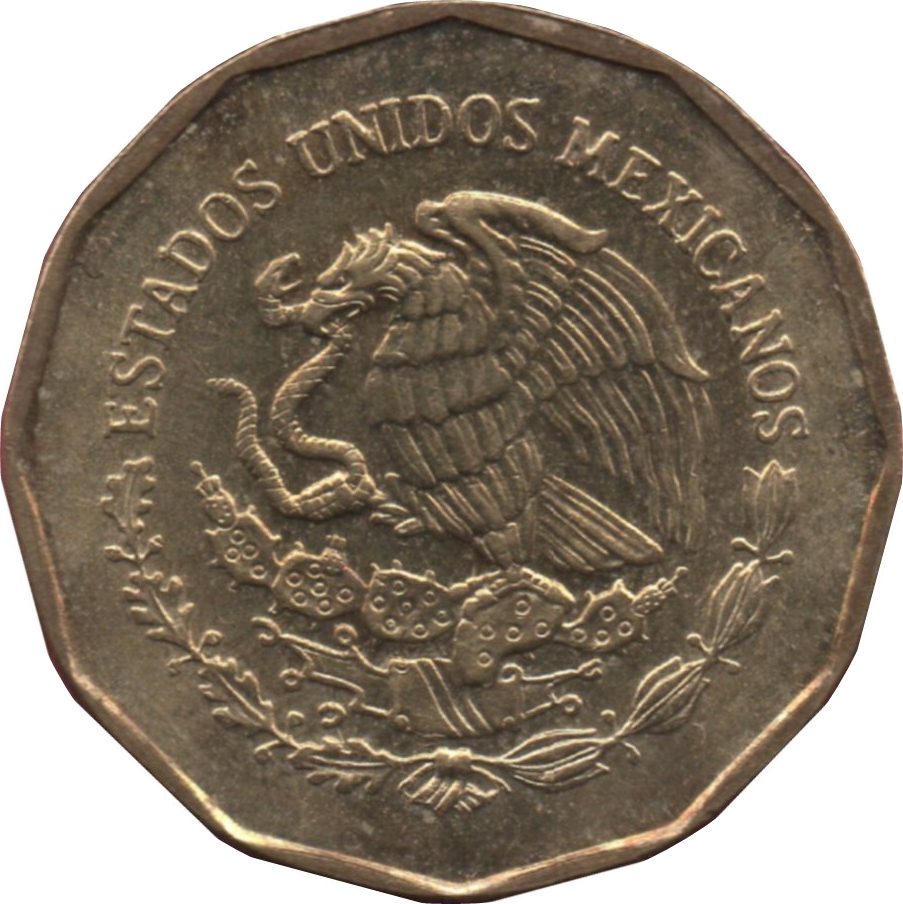
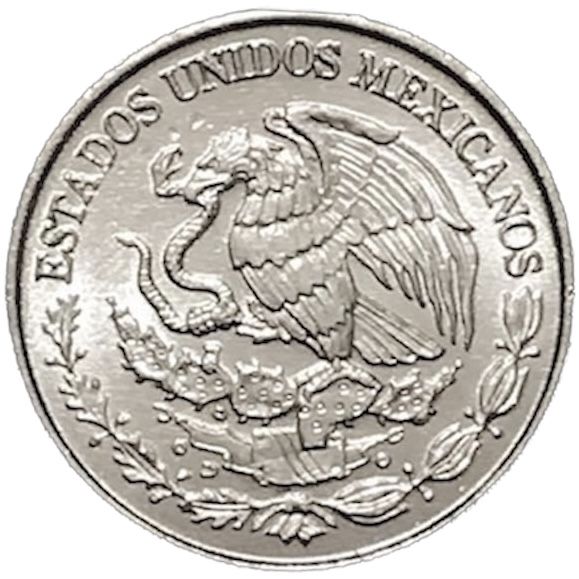
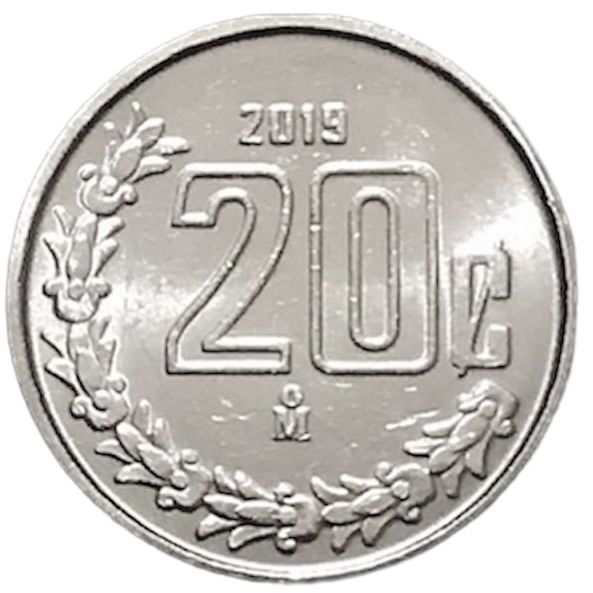
Twenty centavos pairs design continuity with a change of metal and outline. A larger aluminium-bronze coin gives way to the smaller round steel form introduced in 2009.
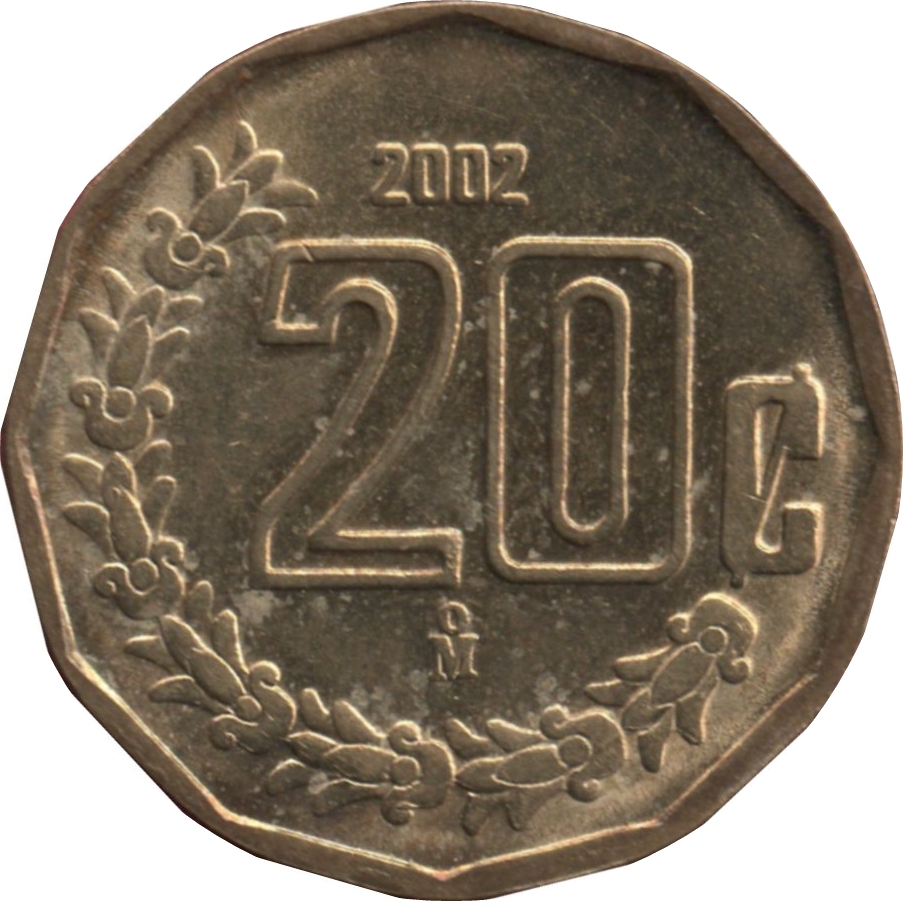
The reverse places 20 and the centavo sign beside a stylized selection associated with Acatl, the thirteenth day on the Sun Stone. The issuer’s name is specific: this is not the Ring of Acceptance used on 50 centavos.
Family B began the modern denomination in January 1993; family C continued from January 1996. The larger form measures 19.5 mm and weighs a nominal 3.04 g.
The reverse places 20 and the centavo sign beside a stylized selection associated with Acatl, the thirteenth day on the Sun Stone. The issuer’s name is specific: this is not the Ring of Acceptance used on 50 centavos. Both physical generations retain the principal Acatl design, making the motif a point of continuity across a substantial change in the object itself.
Family B began the modern denomination in January 1993; family C continued from January 1996. The larger form measures 19.5 mm and weighs a nominal 3.04 g. Its twelve-sided outline has a plain edge. Unlike the large 50-centavo coin, it is not described as a notched dodecagon. The 2002 photograph is a C-era example of this larger form.
The D-family coin entered circulation on 6 August 2009. Its round form measures 15.3 mm and weighs 2.258 g, with interrupted reeding on the edge. Diameter, mass, outline and material all distinguish it from the larger aluminium-bronze coin. The paired comparison keeps the documented 19.5:15.3 diameter relationship; it is an enlarged visual comparison, not a promise of actual screen size.
The old and new coins can appear warm or cool depending on lighting, wear and photography. Their materials are established by specifications: aluminium bronze for the larger B/C form and stainless steel for D. A visible date identifies the photographed example, while the outline and dimensions identify the physical generation. No photograph here is an assay or a measurement of the individual specimen’s mass.
Banco de México lists the larger 20-centavo designs among other valid coins and the D form in the current catalogue. That differs from the withdrawal classification of the larger 10-centavo coin. Sharing an earlier family does not mean sharing a present circulation status. This page preserves the distinction without estimating how commonly either form is found in daily change.
January 1993 marks the monetary lineage, January 1996 the C-family classification, and August 2009 the smaller D form’s release. None is a universal end date for all earlier minting or use. The register keeps these transitions together beneath one denomination. An annual production total, if not established by the sources used here, remains unavailable rather than being inferred from the dates on photographs.
The accepted 50-centavo story offers another bronze-to-steel comparison, but the measurements and shapes differ. Large 50 centavos is 22 mm and 4.39 g; its D successor is 17 mm and 3.103 g. Those values do not belong to 20 centavos. Following the two pages together reveals a coordinated change in small money without erasing each denomination’s identity.
Start dates identify releases or material transitions, not complete mint-year ranges. Missing mass remains unavailable.
Family
Start of circulation / era
Diameter · mm
Mass · g
Composition
Edge
Official status
B
1993-01
19.5
3.04
Aluminium bronze
Plain
Other valid design
C
1996-01-01
19.5
3.04
Aluminium bronze
Plain
Other valid design
D
2009-08-06
15.3
2.258
Stainless steel
Interrupted reeding
Current catalogue
On narrow screens, swipe the table sideways or focus it and use the arrow keys.
THE EVERYDAY OBJECT, IN NUMBERS
Coins in Everyday Mexico
AUGUST 2026 · 20 Centavos
4,432.249
million pieces in circulation
The monthly series began at 902.142 million pieces in January 1999. Its changing balance describes this denomination across designs and generations.
Scale: 0–5,000 million pieces
199920122026
Monthly circulation stock · million pieces
A denomination-level circulation balance, in millions of pieces. It is not annual mintage, newly issued coins, production, monetary value or how often a coin appears in change. The figures do not separate designs or coin families.
Read the monthly figures · 332 observations
Monthly periods; January 1999–August 2026. Scroll within the table for earlier values.
Hero setting: an archival interior, material-study space or architectural landscape artwork. The setting is not a documentary record; the separately shown coin photographs provide the design evidence.
Photographs retain their original coin detail and finish. Exterior background masks are for layout only. The opening detail is an enlarged crop; complete faces appear above and in the design section. Images are enlarged, not actual size; paired faces are design references, not a same-specimen claim.